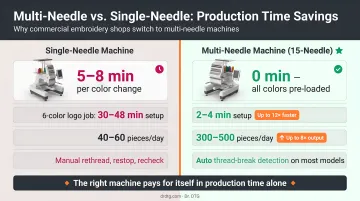
According to Impressions Magazine, eliminating unnecessary trims and color stops compounds into 30-40 minutes of recovered production time per day. Multi-needle platforms turn that math into capacity.
Dr. DTG has spent 23+ years helping shops compare commercial multi-needle options - including Happy Japan Commercial Embroidery Machines and the Xtreme Tech Pro Series (XTPro 1401Ci, XTPro 1501 IPX, XTPro 1502IPX, XTPro XLS) - with demos, hands-on training, and long-term partnership support.
Key Takeaways
- Multi-needle machines (6-15 needles) automate color changes and recover substantial daily production time versus single-needle setups
- Prioritize field size, sustained SPM, hat/cap systems, and after-sale certified repair - not price or needle count alone
- 15-needle configurations give growing shops headroom for complex multi-color logos without mid-job rethread
- Isacord thread, needles, backings, and bobbins protect stitch quality and reduce downtime on high-speed heads
- Dealer training and field-technician access are capacity assets equal to the machine itself
What Is a Multi-Needle Embroidery Machine?
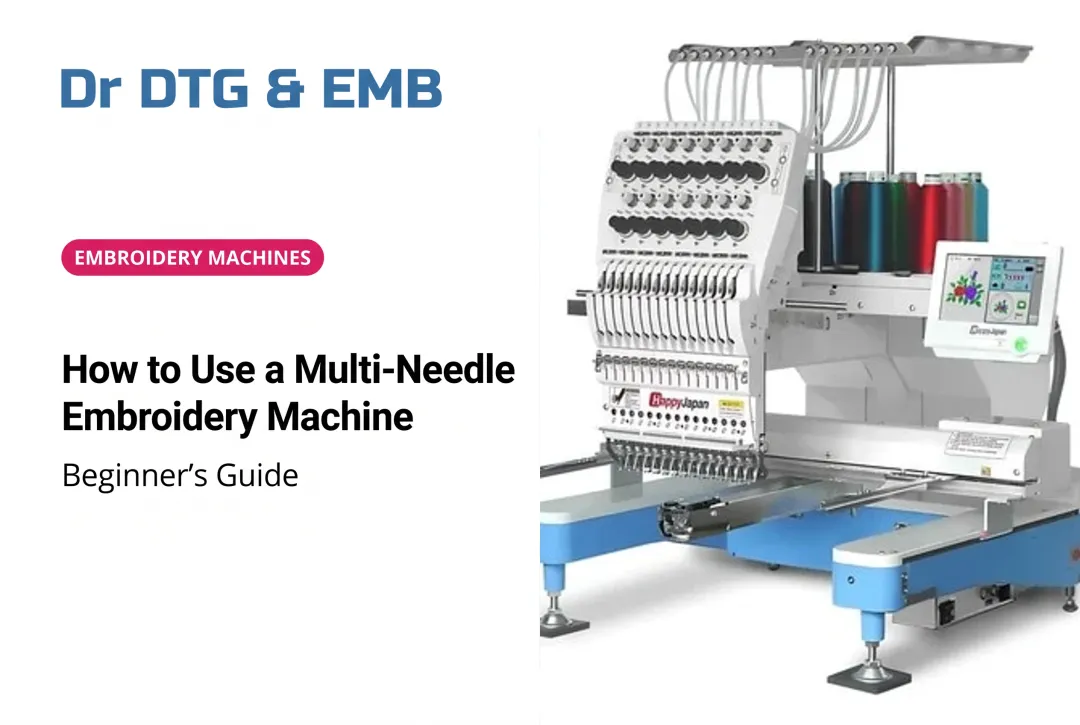
A multi-needle embroidery machine holds a different color on each needle - typically 6 to 15. When the design calls for a color change, the head indexes automatically. No stop, no rethread, no operator idle time per color.
On a single-needle machine, every color change is a full interrupt. On an 8-color left-chest logo, that is eight interrupts per piece. At production volume, multi-needle is the difference between one operator finishing a run and two operators fighting bottlenecks.
Built for:
- Growing commercial embroidery and print shops scaling multi-color output
- Shops adding embroidery beside DTG or screen capacity
- Operators upgrading toward multi-head once single-head volume is saturated
Top Multi-Needle Platforms for Growing Shops
These options span entry commercial to professional production so there is a meaningful choice at each price point and output level.
Xtreme Tech Pro Series XTPro 1501 IPX
Flagship single-head multi-needle for shops that need industrial performance without a factory footprint. The Independent Presser Foot Control System (IPX) adjusts presser foot height per stitch and material - a real advantage on denim, leather, structured hat fronts, and layered workwear.
- 15 needles for complex multi-color designs without mid-job rethread
- Cap frame compatibility for hat embroidery revenue
- Path into XTPro 1502IPX (2-head) when you need to double simultaneous output, plus XTPro 1401Ci entry and XTPro XLS large-area options in the same Xtreme Tech Pro Series family
- 7-year warranty option, on-site training, and certified repair through Dr. DTG
| Specification | Detail |
|---|---|
| Needle Count | 15 |
| Key Features | IPX presser foot, caps, flats, garments, 3D puff |
| Support | 7-year warranty option; SoCal field service; US depot repair |
| Pricing | Contact Dr. DTG - book a demo at 714-770-0969 |
Happy Japan HCD3E-X1501
Happy Japan Commercial Embroidery Machines are manufactured in Japan for long-term commercial duty. The HCD3E-X1501 is a 15-needle single-head with a large flat field (20.5 x 15.74 inches on the standard HCD3 platform), Wi-Fi/LAN/USB, and HappyLAN networking for multi-machine shops.
- Cap field support for finished ballcaps
- Up to 1,200 SPM on flats and 1,000 SPM on caps
- Color LCD with onscreen editing
- Dr. DTG is a USA authorized Happy Japan dealer with OEM parts and factory-aligned technician support
| Specification | Detail |
|---|---|
| Needle Count | 15 |
| Flat Field | 20.5 x 15.74 inches (HCD3 standard) |
| Cap Field | 14.1 x 3.1 inches |
| Top Speed | 1,200 SPM flats / 1,000 SPM caps |
| Connectivity | Wi-Fi, LAN, USB, HappyLAN |
| Pricing | Contact Dr. DTG for current commercial pricing |
Brother PR1055X
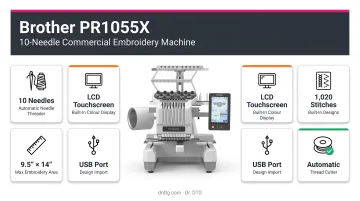
A familiar 10-needle option among recognized commercial embroidery machines, with a strong consumer/semi-pro ecosystem (InnovEye Plus, large built-in library, Wi-Fi apps). Useful for lighter commercial starts, but growing shops should compare field size, cap hardware inclusion, automatic thread cutting, and industrial support depth against Happy Japan and Xtreme Tech Pro Series platforms before committing capital.
| Specification | Detail |
|---|---|
| Needle Count | 10 |
| Flat Field | 8 x 14 inches (max) |
| Cap Field | Optional PRCF3 hardware |
| Top Speed | 1,000 SPM |
Baby Lock Venture 2
Premium 10-needle home/small commercial tier with NeedleCam and IQ Designer tools. Strong placement aids; evaluate total package (cap frames, duty cycle, certified repair access) against production-first commercial lines.
Ricoma MT-1501 (Marquee)
Competitive 15-needle pricing with a large flat field and included cap hardware in many bundles. Compare total cost of ownership - warranty depth, parts, and technician access - against Happy Japan Commercial Embroidery Machines and the Xtreme Tech Pro Series over a 5-10 year horizon.
How Growing Shops Should Choose
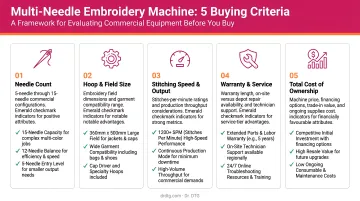
1. Embroidery field size - Impressions recommends buying the largest field you can reasonably afford. Field size is a hard ceiling on jobs you can accept.
2. Stitching speed as throughput - Headline SPM is not net capacity. Color stops, trims, hooping, and hat geometry matter. 15-needle commercial heads at 1,200 SPM on flats give growing shops a real edge on multi-color volume.
3. Needle count - Ten needles cover many logos; fifteen needles keep common colors loaded and cut mid-job rethread on complex art.
4. Connectivity - Wireless/LAN transfer and clear control panels reduce art-to-head friction.
5. After-sale support - Warranty length, OEM parts, certified repair, and field-technician coverage determine downtime cost. Dr. DTG pairs machines with hands-on training and 23+ years of commercial service culture.
Run multi-needle heads on Isacord 40-weight polyester (industrial wash durability, low break rates). Stock matched needles, cut-away/tear-away backings, and bobbins. Dr. DTG carries the full 390-color Isacord catalog as USA Master Distributor - and can supply DTG inks and pre-treatments for hybrid print shops from the same partnership.
Who Should Buy Multi-Needle Now
- Growing commercial embroidery and print shops filling multi-color orders weekly
- Operators who already lose hours to manual rethread
- Decorated apparel businesses adding embroidery beside existing print capacity
- Shops planning a path from single-head to XTPro 1502IPX or Happy Japan multi-head once B2B volume lands
Skip multi-needle only if volume is truly occasional hobby work. These platforms earn their keep on consistent commercial use.
Conclusion
There is no universal "best" multi-needle machine - only the best fit for your volume, hat mix, floor space, and support needs. Prioritize field size, 15-needle flexibility, and certified repair alongside price. A cheaper head that sits idle waiting for parts is not cheaper.
Dr. DTG has guided multi-needle decisions since 2003 (23+ years), with BBB A+ accreditation, demos, training, Isacord supplies, and lines including the Xtreme Tech Pro Series XTPro 1501 IPX / XTPro 1502IPX / XTPro 1401Ci / XTPro XLS and Happy Japan Commercial Embroidery Machines such as the HCD3E-X1501.
Book a demo, consult a technician, or order supplies at 714-770-0969 or drdtg.com.
Frequently Asked Questions
What is the difference between single-needle and multi-needle?
Single-needle requires manual rethread per color. Multi-needle pre-loads colors and changes automatically - the production standard for growing commercial shops.
How many needles do I need?
Ten needles handle many commercial logos. Fifteen needles give headroom for complex multi-color work and fewer mid-job stops - common on Happy Japan HCD3E-X1501 and XTPro 1501 IPX.
What is the best multi-needle start for a growing shop?
Evaluate the Xtreme Tech Pro Series XTPro 1501 IPX and Happy Japan HCD3E-X1501 for 15-needle commercial duty, training, and certified repair. Book a demo to match your order mix.
How much does a multi-needle machine cost?
Commercial single-head multi-needle platforms commonly land in the roughly $10,000-$25,000+ band depending on model and package. Financing is available - consult Dr. DTG for current terms.
What thread works best?
Isacord 40wt polyester is the commercial multi-needle standard. Pair with proper needles, backings, and bobbins. Order through Dr. DTG as USA Master Distributor.
Can multi-needle machines do hats?
Yes. Commercial multi-needle heads with cap frames are the standard path to hat/cap embroidery revenue. Confirm cap hardware and training in your package.