Introduction: Why Hat Embroidery Is a Growth Channel for Commercial Shops
According to PPAI's 2024 sales data, caps and hats grew from 7.2% to 9% of U.S. promotional products sales. For growing commercial embroidery and print shops, that is not a craft trend - it is a revenue channel: teams, corporate merch, small-batch branded headwear, and 3D puff logos that command premium pricing.
Hat embroidery is harder than flat goods. Curved surfaces, thick seams, sweatbands, and a usable design area near 2.25" high x 4" wide punish the wrong machine and the wrong process. This guide covers the commercial hardware, multi-needle advantage, hooping and backings, digitizing rules, and how Happy Japan Commercial Embroidery Machines and the Xtreme Tech Pro Series (XTPro 1401Ci, XTPro 1501 IPX, XTPro 1502IPX, XTPro XLS) support shops scaling hat production with less downtime.
Dr. DTG has spent 23+ years training operators, stocking Isacord thread and Groz-Beckert needles, and providing certified repair so hat programs stay on schedule.
TLDR: Quick Takeaways
- Cap frames are required - flat hoops cannot follow curved crown geometry
- Multi-needle commercial machines are the production standard; single-needle is a low-volume workaround only
- Digitize bottom-up and center-outward to prevent buckling
- Tear-away backings for structured caps; cut-away for unstructured/stretch - wrong stabilizer is the #1 beginner failure
- Practical cap speeds often sit near 600 SPM, not the max SPM on the brochure
- Pair machines with Isacord thread, correct needles, bobbins, and certified repair for consistent commercial output
Key Features of a Commercial Hat Embroidery Machine
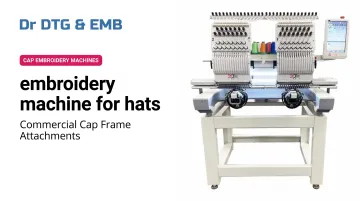
Dedicated Cap Frame System
A 270 degree wide-angle cap frame wraps the hat's cylinder. Melco's published geometry shows why it matters: wide-angle frames cover far more curved surface than conventional cap frames.
A complete system includes:
- Driver rotating with the hat over the arm
- Cap frame holding the hat to the driver
- Jig for repeatable, centered hooping
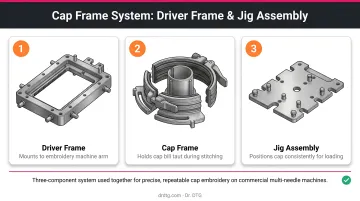
Cylindrical lower arms keep a consistent relationship to the crown through the stitch cycle - better stitch quality than flat-bed architectures fighting the curve.
Needle Count, Speed, Stability
Multi-needle commercial heads (10-16 needles) keep colors pre-loaded so multi-color logos do not stop for manual rethread. That is the difference between profitable hat runs and labor-heavy one-offs.
Manufacturer max SPM may list 1,000-1,200 on commercial machines, but Ricoma and ColDesi guidance often points to ~600 SPM as a practical hat working speed through buckram and dense seams - fewer breaks, cleaner results, less downtime.
Software and Controls
- File formats: .DST, .PES, .EXP and your digitizing stack
- USB / Wi-Fi / LAN transfer
- Touchscreen preview and trace before you commit a blank
- Auto thread-cut and break detection for production runs
- Adjustable presser feet for varying cap thickness - a strength of Xtreme Tech Pro Series IPX presser foot control
Single-Needle vs Multi-Needle for Hat Businesses
Single-Needle
Possible with attachments, but constrained:
- One color at a time
- Slower throughput
- Limited rotating cap driver geometry on many units
- Not built for thick-seam daily duty
Best for: testing demand only - not commercial hat programs.
Commercial Multi-Needle - Happy Japan and Xtreme Tech Pro Series
Dr. DTG carries production lines purpose-built for hat revenue:
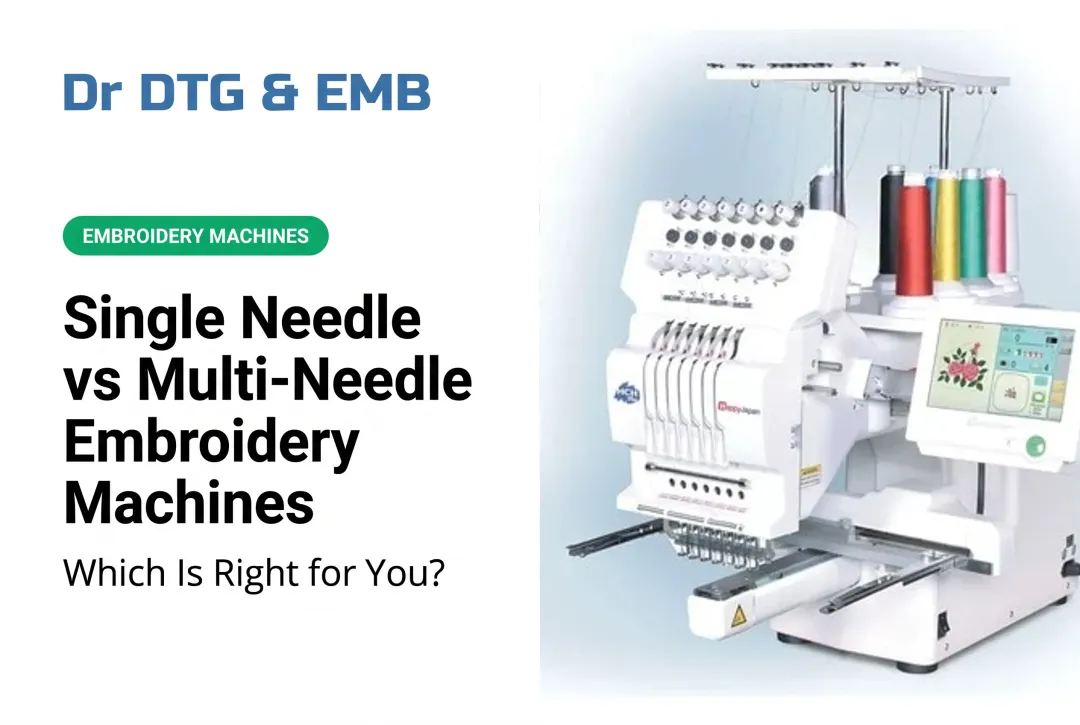
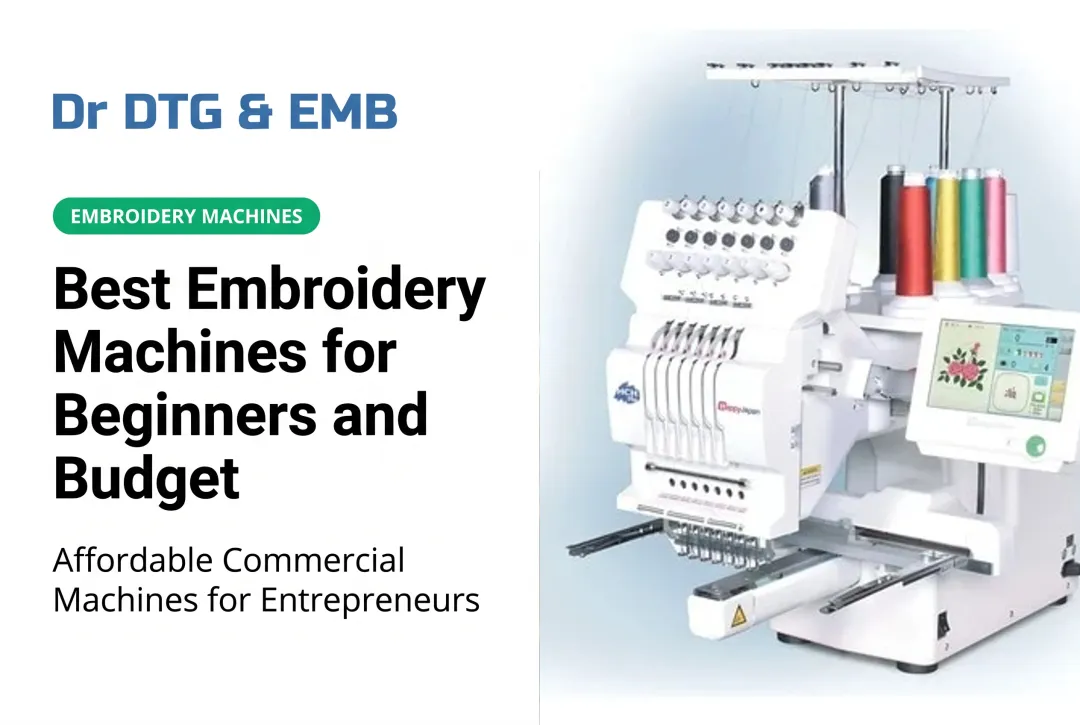
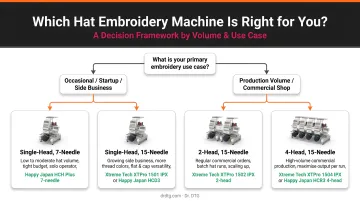
- Happy Japan Commercial Embroidery Machines - HCH Plus (7-needle), HCD3E-X1501 (15-needle), multi-head options - rotating cap frame compatibility as a commercial standard
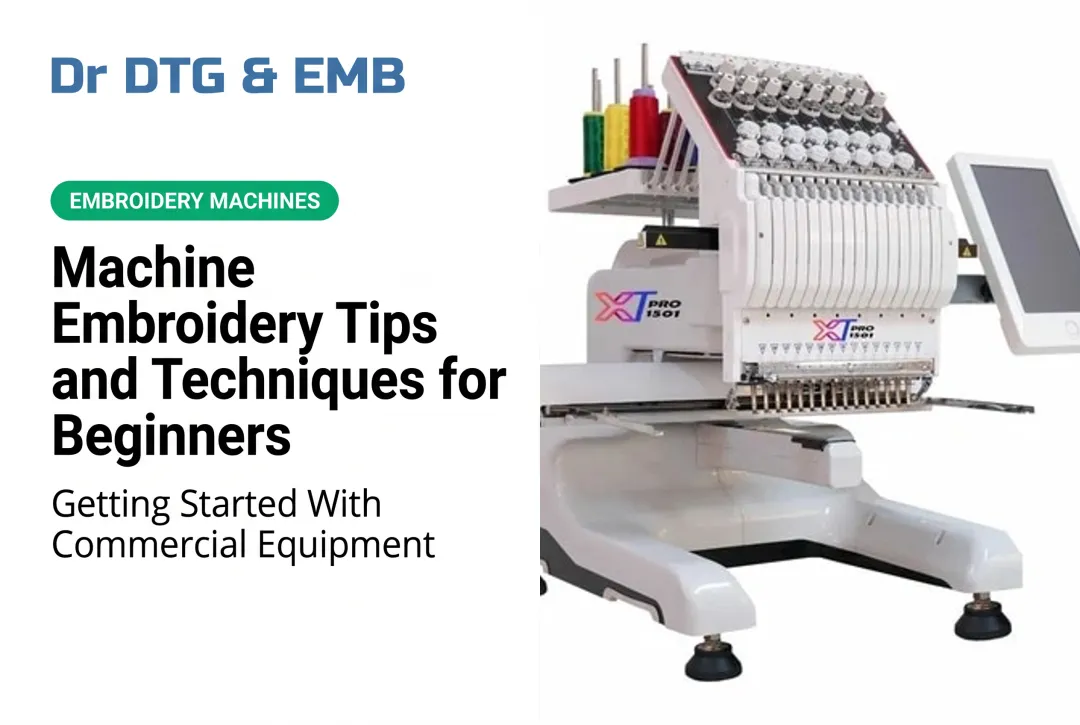
- Xtreme Tech Pro Series - XTPro 1401Ci (14-needle entry), XTPro 1501 IPX (15-needle IPX control), XTPro 1502IPX (2-head for doubling hat batch output), XTPro XLS (large-area companion work)
Both lines ship with financing, trade-in paths, hands-on training, and certified repair - field technicians in Southern California and depot service nationwide.
| Volume / Use Case | Recommended Path |
|---|---|
| 1-10 hats/week, simple designs | Entry multi-needle with cap kit (not long-term single-needle) |
| 10+ hats/week, multi-color logos | 14-15 needle commercial single-head |
| Hats as primary revenue or B2B batches | Multi-needle + path to XTPro 1502IPX / multi-head |
Hooping, Backings, and Stabilization
Structured vs Unstructured
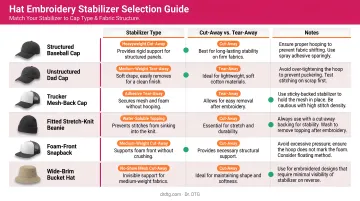
Structured caps (buckram):
- Built-in stability
- Often one layer of tear-away backing
- Always align center seam to frame center mark
Unstructured caps:
- Heavy cut-away backing required
- Fabric moves without buckram - design drift risk
- Double-sided tape on frame before hooping when needed
| Cap Type | Backing Choice |
|---|---|
| Structured with buckram | Tear-away |
| Unstructured or stretch | Cut-away |
| Mesh / textured | Water-soluble topping over primary backing |
Orient the bill away from the machine body and always trace so the design clears the sweatband before you stitch.
Digitizing, Thread, Needles, Bobbins
Digitizing Rule
Impressions Magazine emphasizes center-out and bottom-up digitizing. Start unstable crown-down stitching and you push fabric into buckling. Lock from the stable brim region outward and up.
Keep front designs near 2.25" x 4" (adjust slightly by profile). Reduce density vs flat garments and test on scrap blanks.
Isacord Thread and Needles
Thick caps stress thread. Isacord 40wt polyester is the commercial hat standard - abrasion resistant and colorfast. Dr. DTG is USA Master Distributor of Isacord thread with the full 390-color catalog in 1000m and 5000m spools.
Needle guidance from Madeira and Impressions:
- 75/11 sharp or RG - most hat fabrics
- 80/12 sharp or titanium - heavy buckram
- Change needles as quality drops (~8 hours running time is a common reference; caps dull faster)
Dr. DTG stocks Groz-Beckert commercial needles, bobbins/cases, and backings so hat programs are not waiting on third-party shipping when a rush order lands.
Building a Hat Embroidery Program
Startup Components
| Item | Notes |
|---|---|
| Cap frame driver kit | Required hardware - confirm inclusion in machine package |
| Digitizing software or outsource | Hatch and commercial digitizers common |
| Blank structured caps | Wholesale blanks for samples and stock programs |
| Machine package | Happy Japan or Xtreme Tech Pro Series with training |
Commercial multi-needle machine class pricing is quote-based - book a demo at 714-770-0969 for Happy Japan and Xtreme Tech Pro Series configurations, financing, and trade-in.
Pricing and Models
Many services land near $15-$20 per hat at production quantities plus digitizing setup fees on new art. Structure as service orders (customer blanks) or product-line inventory for higher margin and repeat buys.
Why Vendor Partnership Matters
Hat downtime is lost revenue. Dr. DTG backs machines with:
- On-site service (Southern California) and depot repair (US)
- In-house technicians and OEM parts
- 23+ years supporting the equipment they sell
- Isacord, needles, backings, bobbins - and DTG inks/pre-treatments for hybrid print shops
Frequently Asked Questions
Can a single-needle machine embroider hats?
With attachments, careful setup, and more manual intervention per hat, yes - at low volume. Commercial hat programs need multi-needle free-arm platforms.
What hoop do I need?
A dedicated cap frame system (driver, frame, jig). Flat hoops do not work on crowns.
What stabilizer for hats?
Tear-away for structured buckram caps; cut-away for unstructured/stretch; topping on mesh/texture.
Best needle for hats?
75/11 sharp or RG for most; 80/12 for heavy structured caps. Replace when stitch quality falls.
Best starter hat type?
Structured caps with buckram - more forgiving while operators build process discipline.
How much does hat embroidery cost to run?
Price services competitively; control COGS with Isacord efficiency, correct backings, and machines that stay online via certified repair.