Choosing the Best Embroidery Machine That Makes Patches Not every embroidery machine is built for patch work. Patches demand dense satin-stitch borders, high stitch counts per square inch, and sustained run times that expose the limits of machines designed for occasional home use. The wrong machine shows its weaknesses fast — fraying edges, manual color-change bottlenecks, and output volumes that can't fill orders consistently.

The right machine, sized and specced for your actual production goals, becomes the engine of a profitable patch business. Whether you're running small logo patches for local sports teams or filling regular orders for workwear and military insignia, machine selection shapes everything downstream: cost per patch, defect rate, design complexity ceiling, and how fast you can grow.

This guide breaks down what separates patch-capable machines from general-use alternatives, the key specs that matter most, and how to match your equipment choice to where your business actually is — and where it's heading.


Key Takeaways

  • Hoop size sets your patch size ceiling: a 4"×4" field works for small emblems, but commercial hoop sizes open up shoulder and back patches
  • Needle count controls color-change efficiency; 10–15 needles handle complex multi-color patch designs without production stops
  • 40-weight polyester thread at roughly 0.4 mm stitch density is the practical standard for dense patch embroidery
  • Cut-away stabilizer outperforms tear-away for high-density satin-stitch borders
  • Machine selection should match your current volume — and leave room to scale

What Makes an Embroidery Machine Good for Patches?

Patch embroidery isn't standard embroidery. You're stitching dense fills, thick satin borders, and frequent color sequences onto a substrate that gets cut, finished, and attached to garments that take real wear. That demands more from a machine than a typical monogram or light logo job.

Two machine categories are relevant here:

  • Single-needle machines — suited for hobbyists and small-batch makers who can tolerate manual thread changes and limited output
  • Multi-needle machines : suited for small businesses and commercial patch production, where color changes happen automatically and throughput scales

The specs below determine which category you actually need.

Hoop and Embroidery Field Size

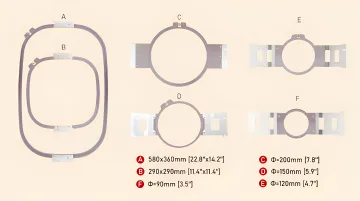
Hoop size sets the hard ceiling on patch dimensions. A 4"×4" embroidery field (like the Brother PE545) handles small emblems and name patches. A 5"×7" field (like the Brother PE900) opens up medium patches and allows gang-hooping of smaller designs in a single run. Commercial fields reach 12.2"×8.3" (Ricoma EM-1010) and up to 19.7"×14.2" (Ricoma Marquee), supporting standard shoulder patches, jacket back patches, and large-format production layouts.

For reference, official military shoulder sleeve insignia run around 2¼"×2¾", while back patches can reach 12"×17" or larger. Your field size determines which of those jobs you can take.

Embroidery hoop field size comparison chart from hobby to commercial patch production

Needle Count

Each needle holds a pre-loaded thread color. On a single-needle machine, every color change is manual — you stop, rethread, and restart. On a 10–15 needle commercial machine, color changes are automatic. For multi-color patch designs, that difference compounds quickly across a production run.

Impressions Magazine notes that multi-needle machines provide faster production speeds and are specifically better suited to quicker color changes on multicolor designs and become a necessity in commercial production for complicated multi-color work.

Stitch Speed and Thread Integrity

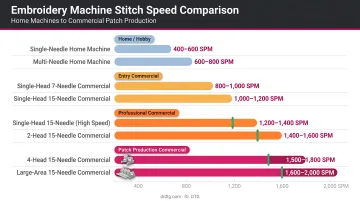
Home machines like the Brother PE545 run at 400 SPM; the PE900 reaches 650 SPM. Commercial machines including the Ricoma Marquee (1,200 SPM) and commercial multi-needle machines like the Xtreme Tech XTPro line (up to 1,200 SPM) operate at a fundamentally different scale for production patch runs.

Speed matters for throughput, but thread integrity matters more for quality. Specialty threads like metallics require slower speeds to prevent breakage. Impressions Magazine recommends settings around 500–600 SPM for metallic-thread runs, with specific guidance varying by thread manufacturer.

Running dense patch borders at maximum speed on a machine without consistent tension control produces puckering and uneven density — two problems that fail patches before they ever leave the hoop.

Embroidery machine stitch speed comparison from home to commercial patch production machines

File Format Compatibility

Format compatibility affects how smoothly digitized designs move from your computer to the machine:

  • Brother machines: primarily .PES, with .DST compatibility on many models
  • Janome machines: .JEF as the default format
  • Commercial machines (Tajima, Ricoma, SWF, and others): typically use .DST, the industry-standard interchange format

If you're outsourcing digitizing, request .DST by default. It's the format professional digitizers deliver and works across virtually every commercial machine platform.


Key Factors When Choosing a Patch Embroidery Machine

Specs tell you what a machine can do. These factors tell you whether it fits your business.

Embroidery Field and Hoop Flexibility

A machine without adequate field size or flexible hoop options forces multiple re-hoopings per patch — which increases setup time, raises misalignment risk, and caps your patches-per-session output. If your patch catalog includes designs above 5"×7", field size becomes a hard requirement, not a preference.

KPI affected: patches per session, setup time per batch

Needle Count and Color Range

The number of needles determines how many thread colors can stay pre-loaded simultaneously. More pre-loaded colors means fewer production stops. For patch designs running 6+ colors regularly, a single-needle machine becomes a bottleneck that limits both throughput and design complexity.

KPI affected: time-per-patch, complexity ceiling

Stitch Speed and Tension Control

Speed without tension consistency produces defects, particularly on the dense satin borders that define patch quality. Machines with automated tension or controlled thread-feed systems (such as those found on Happy Japan commercial heads) maintain stitch integrity at higher speeds and reduce the manual intervention that slows production.

Barudan's technical documentation directly links improper tension to visible defects: looping from over-loosened tension, puckering from over-tightened tension. Both are common failure modes in dense patch embroidery.

KPIs affected: defect rate, thread break frequency, overall throughput

Build Quality and Duty Cycle

Patch production means high stitch counts per piece, run after run. Machines with plastic internal components or lightweight frames wear faster under sustained commercial use. Commercial-grade machines — built with metal frames and industrial components — are engineered for continuous professional output. Happy Japan machines, for example, are known for production-environment longevity; many remain in active service after 20+ years.

KPI affected: maintenance frequency, downtime, long-term cost-per-patch

Software, Warranty, and Support

Two factors that buyers often underweight:

  • File format support and software compatibility determine how quickly digitized designs reach production. A machine requiring conversion steps on every file adds friction to every order.
  • Warranty coverage and repair access determine what a breakdown actually costs you. A commercial machine without responsive support turns a maintenance issue into a revenue gap.
  • Training and onboarding affect how fast your team reaches full production speed. Dealers that offer hands-on setup support help you avoid the costly trial-and-error period that slows new operators down.

Matching Your Machine to Your Patch Production Goals

Hobbyists and Small-Batch Makers (Under 50 Patches/Month)

Entry-level single-needle machines have a low upfront cost and straightforward operation. The trade-off is predictable: color changes are manual, output is limited, and multi-color designs slow considerably.

These machines work for prototype runs, simple 1–3 color patches, and testing designs before scaling.

Growing Businesses (Consistent Patch Orders)

This is where the upgrade to multi-needle commercial equipment pays off. A 10–15 needle machine keeps colors pre-loaded, maintains automatic color changes, and runs at commercial speeds — eliminating the manual delays that cap single-needle output.

The embroidery machine market reflects this trajectory: Mordor Intelligence sizes the global embroidery machine market at USD $1.27 billion in 2026, growing to USD $1.7 billion by 2031 at a 6.01% CAGR. That growth is driven by exactly this segment — small operators scaling into commercial production. For businesses at this stage, 10–15 needle commercial machines are the practical standard. The Xtreme Tech XTPro 1401Ci (14 needles) offers a capable mid-range entry point, while the XTPro 1501 IPX (15 needles) handles more complex designs without interruption. On the Happy Japan side, the HCD3E-X1501 (15 needles) delivers comparable commercial-grade performance for shops ready to commit to consistent patch volume.

High-Volume and Professional Patch Producers

At scale, the economics shift. Higher upfront machine cost is offset by lower per-patch costs, fewer defects, less operator intervention, and the ability to run more complex designs without bottlenecks. Industrial 15-needle systems — or multi-head configurations that run 2–4 heads simultaneously — deliver multiplied output from a single operator.

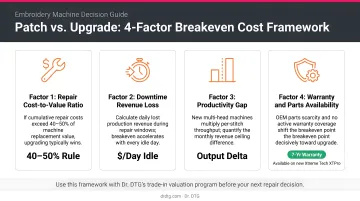
Use this breakeven framework to pressure-test the upgrade decision:

  • Machine cost per patch: monthly payment ÷ average monthly patch output
  • Labor cost per color change: time spent × hourly rate × average color changes per design
  • Defect/rework cost: scrap rate × material and labor cost per patch
  • SPM impact: faster stitch speeds compress production time on every order

Four-factor patch machine upgrade breakeven cost analysis framework infographic

For most shops running consistent patch orders, the crossover point typically appears well before hitting full machine capacity — often within the first 90 days of commercial-volume output.


Essential Supplies That Impact Patch Quality

Machine capability only goes so far — thread weight, stabilizer type, and backing choice directly shape whether a finished patch holds up or falls apart.

Thread: Weight and Fiber Type

For patch production, 40-weight polyester is the industry standard. Isacord 40 (per Amann's specs) is a trilobal continuous-filament polyester — Tex 27 construction, 390 colors — built to handle dense satin-stitch borders at commercial speeds without shredding or color fade.

Dr. DTG stocks the full Isacord 40 catalog as the USA Master Distributor — individual 1,000m spools at $5.29, 5,000m production spools at $9.95, and pre-curated 50-spool kits for shops building out color inventory. Volume pricing is available; call 714-770-0969 for wholesale rates.

Stabilizer Selection

Stabilizer Type Best Use Case Patch Application
Cut-away Non-stable fabrics, dense fills Best for most patches — locks stitch structure permanently
Tear-away Stable woven fabrics, lighter designs Risk of shifting under high-density satin borders
Water-soluble (topping) Loop-pile fabrics, textured substrates Used as a top layer to prevent thread sink-in

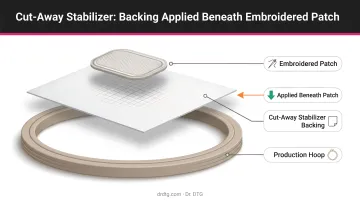
For most patch production, cut-away is the right call. It provides permanent structural support that holds up through washing and wear — important for patches that end up on uniforms, workwear, and gear that gets real use.

Cut-away stabilizer backing applied beneath embroidered patch on production hoop

Patch Backing Options

Backing choice should match the end application:

  • Sew-on — most durable; standard for uniforms, tactical gear, workwear
  • Iron-on (heat seal) — semi-permanent; convenient for fashion garments and casual applications
  • Velcro/hook-and-loop — removable; common for military and interchangeable patches
  • Adhesive peel-and-stick — temporary; useful for placement testing or short-term display

Backing selection also affects stabilizer planning — if iron-on backing is applied before embroidery, that layer changes how the substrate behaves under the needle.

How Dr. DTG Supports Patch-Making Entrepreneurs

Dr. DTG is a BBB Accredited (A+-rated) commercial embroidery machine specialist headquartered in Brea, California, operating since 2003. The company's focus is on equipping small businesses and aspiring entrepreneurs to build profitable embroidery operations — with training, service, and supplies included alongside the hardware.

For patch production, the relevant machine offerings include:

  • Xtreme Tech XTPro line — available in 14-needle (1401Ci) and 15-needle configurations (1501 IPX, 1502 IPX two-head, 1504 IPX four-head, XLS large-area), with the XTPro 1501 IPX featuring an Independent Presser Foot Control System designed for cleaner stitching on thick and layered materials
  • Happy Japan HCD3E-X1501 — a 15-needle Japanese-manufactured machine known for long-term production reliability, with many Happy machines remaining in active commercial service after 20+ years

Both lines come with Dr. DTG's full support infrastructure:

  • 7-year warranty on Xtreme Tech XTPro machines
  • On-site repair service for Southern California customers
  • Return-to-depot repair for shops across the rest of the US

For shops outgrowing their entry-level equipment, Dr. DTG's trade-in program accepts single-needle and beginner machines toward commercial upgrades — a straightforward path to higher-volume production. Financing is available for all machine lines, including 100% equipment financing with Section 179 tax advantages.

For shops sourcing both equipment and supplies from a single partner, Dr. DTG's Master Distributor status for Isacord Thread means the team that sells and services your machine also supplies your thread.


Conclusion

The best embroidery machine for patches isn't the most spec-heavy model on the market — it's the one that matches your current production volume, handles your design complexity without bottlenecks, and has the build quality and reliable service support to keep running when production pressure increases.

For most patch businesses, that decision comes down to a clear inflection point: single-needle machines for low-volume and prototype work, multi-needle commercial machines once consistent orders arrive. And that choice doesn't have to be final — as volume grows, upgrading or trading in your current machine is a straightforward next step, not a setback.

If you're still weighing your options, Dr. DTG offers pre-purchase machine demos, financing, and a trade-in program specifically for embroiderers scaling up. It's worth seeing how a machine performs on actual patch material before committing.


Frequently Asked Questions

What embroidery machine is best for patches?

The answer depends on production scale. Single-needle machines like the Brother PE800 work for hobbyists and simple small-batch designs, but multi-needle commercial machines in the 10–15 needle range are the standard for consistent patch business production — they eliminate manual color-change stops and run at commercial speeds.

Can a single-needle machine make professional-quality patches?

Yes, stitch quality can be professional, but every color change requires stopping and rethreading manually. Single-needle machines work best for simple 1–3 color designs or prototype runs — not for high-volume or multi-color patch production.

What stabilizer should I use for patch embroidery?

Cut-away stabilizer is the best choice for most patches. It permanently supports dense satin-stitch borders and holds up through washing and wear. Tear-away can work for lighter designs but risks shifting under high-density stitching.

How many needles do I need for multi-color patch designs?

A 10-needle machine handles most complex patch designs without interruption by keeping colors pre-loaded; a 15-needle machine adds flexibility for intricate multi-color artwork. As a practical baseline, aim for at least as many needles as the dominant color count in your standard designs.

What file format do I need for patch production?

Home machines use brand-specific formats — PES for Brother, JEF for Janome. Commercial machines use DST, the universal industry interchange format and the safest choice to request when outsourcing patch digitizing.