The right call depends on four things: how much you're ready to spend upfront, how complex your designs are, who you're selling to, and whether you're building an online store or a local print shop. This article walks through each factor so you can make the decision with confidence.
Key Takeaways
- Heat presses cost as little as $300–$1,000 to get started; commercial DTG printers typically start around $15,000–$20,000
- DTG excels at photorealistic, full-color designs on cotton with no per-design setup cost
- Heat press is faster for simple, repeat designs and works across more fabric types
- DTG is the stronger choice for online, on-demand stores; heat press suits local and event-based businesses
- Many successful apparel shops run both: starting with a heat press, then adding DTG as order complexity and volume increase
DTG Printer vs Heat Press: Quick Comparison
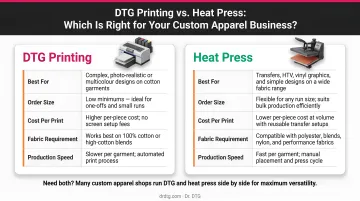
| Factor | DTG Printer | Heat Press |
|---|---|---|
| Upfront Cost | ~$15,000–$20,000+ | ~$300–$1,000 |
| Best Fabric | 100% cotton or high-cotton blends | Polyester, blends, cotton, nylon |
| Design Complexity | Photorealistic, unlimited colors | Bold, 1–3 color graphics |
| Dark Garments | Requires pretreatment | Works without extra steps |
| Production Speed | Up to 40–55 garments/hour (model-specific) | ~120 garments/hour (simple transfers) |
| Maintenance | Printhead cleaning, ink management, pretreatment calibration | Minimal — temperature and timer checks |
| Minimum Orders | None | None |
| Learning Curve | Moderate to steep | Low |
What is a DTG Printer?
DTG (Direct-to-Garment) printing works exactly like a desktop inkjet printer — except instead of paper, it prints onto fabric. Water-based inks are sprayed directly onto the garment, where they bond into the fiber rather than sitting on top. The result is a soft, breathable print that's part of the shirt rather than a layer on it.
The DTG Workflow
From a business operations standpoint, every DTG job follows four steps:
- Garment preparation — Light-colored shirts go straight to the platen; dark garments need pretreatment solution applied evenly and dried before printing
- Platen loading — The garment is stretched flat onto the platen (print surface) and locked into position
- Printing — The machine runs the design automatically from a digital file; no screens, no plates, no setup per design
- Curing — The printed garment passes through a heat tunnel or sits under a heat press to bond the ink permanently
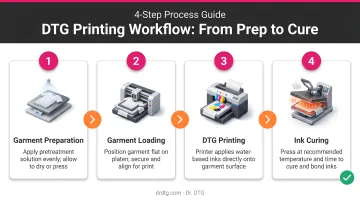
Each step affects output quality. Inconsistent pretreatment is the most common cause of patchy prints on dark garments — it's a process skill that takes practice.
Why DTG Works for On-Demand Businesses
The business case for DTG centers on three advantages:
- No minimum order quantity — print one shirt or one hundred with no per-design changeover cost
- Unlimited colors at no extra cost — a 47-color gradient costs the same to print as a two-color logo
- No physical setup — no screens to burn, no dies to cut, no films to print separately
The print-on-demand market was valued at $10.78 billion in 2025 and is projected to reach $57.49 billion by 2033, growing at a 23.6% CAGR. DTG is the production method behind most on-demand fulfillment operations — no inventory required, no minimums, no waste on unsold stock.
Fabric and Garment Limitations
DTG performs best on 100% cotton or high-cotton blends. Natural fibers absorb water-based inks efficiently, which produces sharp, vibrant results. Polyester and synthetic blends present a specific challenge: dye migration can bleed from the fabric into the ink layer, causing color shifts that are difficult to correct.
White and light-colored garments are the easiest starting point. Dark garments are printable but require pretreatment to create a white underbase, which adds time and consistency demands.
Use Cases for DTG Printers
DTG fits best when your business model looks like this:
- Online stores on Shopify, Etsy, or Amazon Merch selling unique, frequently changing designs
- Print-on-demand fulfillment with no inventory risk
- Personalized gifts (photo prints, custom names, one-of-a-kind artwork)
- Limited-edition drops where every design runs in small quantities
- Small-batch promotional merchandise for businesses or events
Dr. DTG carries DTG printers built for commercial output, backed by a 5-year warranty and financing options — useful if you're evaluating the upfront cost of entering this market.
What is a Heat Press?
A heat press uses a combination of heat and pressure to permanently bond a decoration onto a garment. The decoration itself is prepared separately — either cut from colored vinyl (HTV) using a cutting machine, or printed onto transfer film using a separate printer.
Two Main Types of Heat Transfer
Cut vinyl (HTV): A cutting machine slices shapes out of colored vinyl sheets. Layers are weeded and pressed onto the garment. Works best for bold, single- or multi-color designs like text, logos, and team numbers.
Digital heat transfer (printable film): A full-color design is printed onto special transfer film, then pressed onto the garment. Supports complex artwork and photos without a DTG printer, though the tactile result differs.
Why Heat Press Wins on Accessibility
The heat press process is straightforward to learn:
- Prepare your design (in cutting software or via a print provider)
- Cut or receive your transfer material
- Position the transfer on the garment
- Apply heat and pressure for the specified time (often 15–20 seconds for standard transfers)
- Peel the carrier sheet
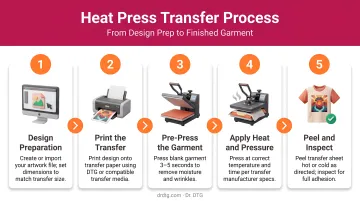
Entry-level clamshell heat presses start around $300, with swing-away packages around $1,010. Dr. DTG's Automatic Heat Press 16x20 (handles adult shirt fronts, jacket backs, and larger logos) is available at $1,050 — well under the entry cost of a commercial DTG printer.
Business Limitations to Know
That accessibility advantage comes with trade-offs. As order volume and design complexity increase, the heat press starts to show its limits:
- Vinyl transfers have a raised, slightly textured feel that customers notice compared to DTG's soft print
- Complex multi-color vinyl designs require layering multiple pieces — more time, more error risk, higher material cost
- Digital heat transfers can crack or peel over time with aggressive washing or high-heat drying
- High-volume, full-color custom orders become inefficient compared to DTG
Use Cases for Heat Presses
Heat press is the right tool when:
- You're launching with limited startup capital and want to test the market first
- Your core customers are schools, sports teams, or local businesses needing bold logo apparel
- You need flexibility across product types — shirts, bags, caps, and mugs (with appropriate attachments)
- Your designs are primarily text, team names, numbers, or simple graphics
- You want a setup that's fast to learn and easy to manage solo
DTG Printer vs Heat Press: Which is Better for Your Business?
Neither machine is universally better. The right choice comes down to where your business is right now and where you're taking it.
Choose a DTG Printer If:
- You're building an online, on-demand store where every order is unique
- Your designs involve gradients, photographs, or fine illustration detail
- You want to eliminate inventory risk entirely
- You're ready to invest in commercial equipment and manage ongoing ink and pretreatment costs
- Your primary garments are cotton-rich — t-shirts, hoodies, tote bags
Choose a Heat Press If:
- Your startup budget is limited and you want to validate demand before a major investment
- Your customers want team names, school logos, simple corporate branding
- You serve local markets where face-to-face relationships drive orders
- You want to decorate a wide range of product types including polyester and blends
- You're operating solo and need minimal daily maintenance overhead
The Hybrid Approach
Many successful custom apparel businesses run both machines, though rarely from day one. A common pattern: start with a heat press to serve local customers and build consistent monthly revenue, then add a DTG printer once the order mix shifts toward complex, photorealistic designs that the heat press can't handle efficiently.
That progression is easier when your equipment supplier is set up to grow with you. Dr. DTG's financing options and trade-in program are designed for exactly this kind of staged investment — so you're not tying up capital in equipment before the business has proven its order mix.
For personalized guidance on which path fits your situation, the team at Dr. DTG (714-770-0969 or info@drdtg.com) offers pre-purchase consultations to help you make the call with real numbers in front of you.
Conclusion
There's no universal winner in the DTG vs. heat press decision. DTG leads on design quality, color range, and on-demand flexibility. Heat press leads on startup affordability, fabric versatility, and simplicity. What matters is which strengths match your current business stage.
If you're building an online store around unique, full-color designs, DTG is the right long-term investment. If you're starting local with simple graphics and a tight budget, a heat press gets you profitable faster. If you're somewhere in between, the hybrid approach gives you a clear upgrade path without committing everything upfront.
Dr. DTG has been helping decorators, small businesses, and custom apparel entrepreneurs choose the right printing equipment since 2003. If you're weighing your options, reach out at 714-770-0969 or info@drdtg.com for personalized guidance on the right machine for your stage of business.
Frequently Asked Questions
Should I do DTG or DTF printing?
DTG prints ink directly onto the garment for a soft, fabric-integrated feel — best for cotton-rich apparel and detailed artwork. DTF (Direct-to-Film) prints onto a special film that's then heat-pressed onto the garment, making it compatible with more fabric types and a wider range of blends.
Does DTG printing feel like vinyl?
No. DTG ink absorbs into the fabric fibers, creating a soft, breathable print that's barely noticeable to the touch. Vinyl heat transfers sit on top of the garment surface with a raised, slightly rubbery texture — a distinction you'll notice immediately.
Is a DTG printer or heat press cheaper to start with?
A heat press is significantly cheaper — entry-level machines start around $300, with commercial options around $1,000–$1,050. Commercial DTG printers typically start at $15,000–$20,000. Financing is available through Dr. DTG, which can make DTG equipment more accessible for entrepreneurs scaling up.
Which method is better for small orders?
DTG has the clear edge for small runs of complex, multi-color designs — there's no per-design setup cost, so one piece costs the same to print as ten. Heat press suits small quantities of simple, bold graphics where setup time and material cost stay low.
Can you use a heat press on any fabric?
Heat press works on a wide range of fabrics including cotton, polyester, blends, and nylon — wider compatibility than DTG. The transfer material must match the fabric type, and heat-sensitive fabrics require lower temperature settings or specialty transfer products.
How long do DTG prints last compared to heat press transfers?
Properly cured DTG prints are highly durable and can last the life of the garment with correct care — cold water wash, inside-out, gentle cycle. Cut vinyl transfers are also durable, but digital heat transfers rated at 50 wash cycles can crack or peel faster with high-heat drying or aggressive washing.