The appeal is real. No screens. No minimum orders. No expensive setup every time a customer wants a new design. But the wrong machine can quietly drain your operating budget through high ink costs, frequent downtime, or a print size that limits what you can sell.
This guide breaks down the top DTG printers for small businesses, what separates them, and how to match the right machine to where your business actually is — not where you hope it'll be in three years.
Key Takeaways
- DTG printers produce full-color, photo-realistic prints on demand with minimal setup — ideal for small-batch and one-off orders
- Entry-level machines start around $4,995–$5,000; mid-tier models cluster between $13,000–$16,000
- White ink handling is the most critical spec to evaluate: poor circulation causes head clogs that halt production and drive up cleaning costs
- Factor in ink, pretreatment, cleaning, and maintenance costs — total cost of ownership routinely exceeds the machine's purchase price
- Vet vendor support before buying: response time, warranty length, and whether repairs are on-site or depot-based directly affect how long your shop sits idle
What Is DTG Printing and Why Does It Matter for Small Businesses?
DTG (Direct-to-Garment) printing uses inkjet technology to apply water-based pigment ink directly onto fabric — the same general mechanism as a desktop printer, but engineered for garments. The result is photo-realistic, full-color output without color separations, screens, or transfer films.
For small businesses, that means three practical advantages:
- No setup fees per job — each design prints from a file, so one-offs cost no more to set up than bulk runs
- No minimum quantities — you can profitably print a single shirt without absorbing screen-making costs
- Fast turnaround — according to Impressions Magazine, DTG offers quick turnaround with "almost no setup costs" compared to traditional decoration methods
Those advantages only hold if DTG is the right method for your product mix. Here's how it compares to the most common alternatives:
| Method | Best For | Limitation |
|---|---|---|
| DTG | Small batches, full-color cotton prints, on-demand | Less cost-effective on large runs |
| Screen printing | High-volume, simple designs | Setup costs make short runs expensive |
| DTF | Polyester, blends, non-cotton substrates | Thicker hand feel; requires transfer step |
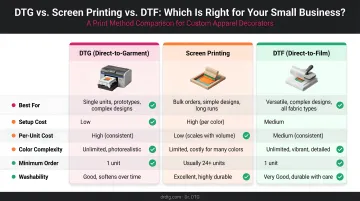
DTG performs best on 100% cotton or high-cotton blends. If your product range is heavily polyester or synthetic, DTF (Direct-to-Film) may be a better fit — though several modern DTG machines now support both workflows.
Best DTG Printers for Small Business
These printers were selected based on print quality, ease of use, total cost of ownership, and suitability for small-to-mid production volumes.
Epson SureColor F1070
The F1070 is Epson's entry-level DTG machine and the clearest starting point for first-time buyers. It supports both DTG and DTFilm workflows, fits comfortably in a small space, and runs on Mac or Windows without special configuration.
| Spec | Detail |
|---|---|
| Max Print Size | 10" × 12" |
| Max Resolution | 2400 × 1200 dpi |
| White Ink Circulation | Built-in |
| OS Compatibility | Mac + Windows |
| Current Price | ~$4,995 |
The F1070 handles fabric up to 1" thick with automatic height adjustment — useful for hoodies and thicker garments. Its PrecisionCore MicroTFP printhead produces sharp, accurate color. At under $5,000, it's the most accessible commercial DTG option currently on the market.
Best for: Solo operators, home-based print businesses, and entrepreneurs testing the waters before scaling.
Epson SureColor F2270
The F2270 is the natural next step for shops that have outgrown the F1070's 10" × 12" print area or need consistent dark garment output at higher volume.
| Spec | Detail |
|---|---|
| Max Print Size | 14" × 16" standard; up to 16" × 20" with large platen |
| White Ink Circulation | Built-in |
| OS Compatibility | Mac + Windows |
| Current Price | ~$12,995 |
The built-in white ink circulation is what makes the F2270 production-capable on dark shirts — without it, white ink settles and clogs. The larger platen opens up adult-sized full-front prints and oversized designs that the F1070 can't accommodate.
Best for: Growing shops printing 15–40 shirts daily across light and dark garments.
Ricoh Ri 1000
The Ri 1000 differentiates itself with business-management features that the Epson lineup doesn't match at this price point. Its ColorGATE software calculates ink cost per garment automatically — a practical advantage when you're tracking margin on every order.
| Spec | Detail |
|---|---|
| Max Print Size | 12.6" × 18" standard; 16" × 19.6" with large platen |
| White Ink Circulation | Automatic (runs hourly) |
| OS Compatibility | Windows only |
| Touchscreen | 7" interactive display |
| Current Price | ~$15,000 |
Ink costs around $0.328–$0.35 per ml depending on volume purchased, with XL cartridges offering slightly better per-ml pricing. The hourly white ink circulation is a practical detail: Ricoh's own documentation confirms that disrupted circulation allows ink to settle in printheads, causing clogs — so automated agitation matters.
Best for: Windows-based shops that want transparent cost tracking and strong manufacturer support infrastructure.
Brother GTXpro
The GTXpro is the highest-output option in this tier and the only machine here with a verified maximum print area of 16" × 21" — useful for oversized prints, long-body shirts, and specialty garments.
| Spec | Detail |
|---|---|
| Max Print Size | 14" × 16" standard; 16" × 21" with accessories |
| Workflow | DTG + DTF hybrid |
| OS Compatibility | Mac + Windows |
| Current Price | ~$15,995 |
Brother markets the GTXpro's ability to print over zippers, seams, and pockets — useful for workwear, outerwear, and structured garments. Its hybrid DTG/DTF capability gives shops flexibility without a second machine.
Best for: Shops with consistent order volume who need larger print areas and multi-substrate flexibility.
Xtreme Tech Pro 1501 (Available Through Dr. DTG)
The Xtreme Tech Pro 1501, available through Dr. DTG, is built for small business owners who need reliable output and hands-on support — not just a machine shipped to their door with a manual.
| Spec | Detail |
|---|---|
| Warranty | 5-year coverage with personalized repair and support |
| Service Model | On-site (Southern California) or depot service (all other US states) |
| OEM Parts | Full inventory on-site in Brea, California |
| Pricing | Contact Dr. DTG directly — drdtg.com or 714-770-0969 |
Dr. DTG has been in the garment printing business for over 20 years, holds a BBB A+ accreditation, and employs technicians who service the same machines they sell — with a full OEM parts inventory on-site in Brea, California. That combination of in-house expertise and parts availability means faster turnaround when something needs attention.
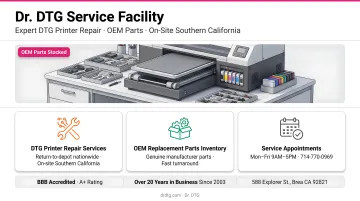
Best for: Aspiring entrepreneurs and small shop owners who want reliable output, financing options, and a dedicated support relationship.
Key Factors When Choosing a DTG Printer for Small Business
White Ink Handling
White ink is the most critical variable in DTG printing and the most common source of expensive downtime. Because dark garment prints require a white ink underbase, you'll use more white ink than any other color — and it's significantly more prone to clogging.
Prioritize machines with automatic white ink circulation. The Ricoh Ri 1000 runs circulation every hour; both Epson models include built-in circulation systems. Humidity also matters: Ricoh's support documentation warns that environments below 45% RH accelerate ink drying and nozzle clogging.
Total Cost of Ownership
The sticker price is only part of the equation. Calculate these before committing:
- Ink cost per ml — varies meaningfully by brand and cartridge size
- Pretreatment liquid — required for all dark garment printing; adds per-shirt cost
- Maintenance and cleaning supplies — daily upkeep for white ink systems is non-negotiable
- Consumables and replacement parts — printheads, capping stations, and maintenance kits
A budget machine that costs $5,000 upfront but carries high per-ml ink prices and frequent maintenance issues can cost more to operate over 12 months than a mid-tier machine with efficient ink usage.
Print Volume and Speed
Match the machine to your realistic daily output, not your optimistic projection. For most entry to mid-tier small businesses:
- Under 15 shirts/day: F1070 handles this comfortably
- 15–40 shirts/day: F2270 or Ri 1000 is a better fit
- 40+ shirts/day: GTXpro or commercial-grade machines
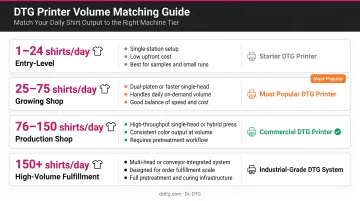
Buying more capacity than you need ties up capital. Buying too little creates bottlenecks that cost you customers.
Fabric Compatibility
DTG performs best on 100% cotton or high-cotton blends. Polyester and synthetic fabrics create dye migration problems at standard curing temperatures: the fabric's dye releases into the ink layer and muddies colors. The Epson F2270's user guide notes compatibility with cotton/polyester blends from 50% to 100% cotton, but results vary.
If you plan to print on poly blends, hoodies, or specialty materials regularly, verify compatibility before purchase. A DTG/DTF hybrid machine may give you more flexibility across fabric types.
Vendor Support and Warranty
Printer downtime costs a small business real money: missed deadlines, turned-away orders, and idle labor. Before committing to any machine, evaluate:
- Warranty length and what's covered (parts, labor, printheads)
- Whether service is on-site or depot-only
- Average response time for repair tickets
- Whether the vendor stocks OEM parts
A specialist dealer — one with in-house technicians, an OEM parts inventory, and a track record in the industry — will get you back running faster than a generalist retailer routing you through a call center. Dr. DTG, for example, offers on-site service in Southern California and depot repair across the US, backed by over 20 years in the business.
Frequently Asked Questions
What is the average cost of a DTG printer?
Entry-level commercial DTG printers start around $4,995 (Epson F1070), while mid-tier models like the F2270, Ricoh Ri 1000, and Brother GTXpro run $13,000–$16,000. Beyond the purchase price, budget for ink, pretreatment, cleaning supplies, and maintenance.
Which is the best DTG printer for a small business?
It depends on volume and support needs. The Epson F1070 is the strongest entry-level option. The Ricoh Ri 1000 offers transparent cost tracking and solid manufacturer support for growing shops. For buyers who want expert-backed guidance and long-term service, the Xtreme Tech Pro 1501 through Dr. DTG includes a 5-year warranty and personalized support.
Is DTG printing profitable for a small business?
Yes — especially for print-on-demand and custom orders where no-minimum production is the advantage. Profitability depends on controlling ink and pretreatment costs, pricing accurately, and buying the right machine for your volume from the start.
What fabrics work best with DTG printing?
100% cotton produces the best results — natural fibers absorb water-based inks far better than synthetics. High-cotton blends (80%+) perform well, but polyester and synthetics carry dye migration risks at curing temperatures. For primarily synthetic runs, DTF is often the better choice.
How often does a DTG printer need maintenance?
Daily maintenance is standard — particularly for white ink systems, which require regular agitation or circulation to prevent settling and clogging. Machines with automatic circulation cycles reduce manual upkeep significantly. Capping station care, humidity management, and periodic deep cleaning are part of long-term ownership for any DTG printer.
What is the difference between DTG and DTF printing?
DTG prints ink directly onto the garment — best for cotton, with a soft hand feel. DTF transfers a design via film and adhesive powder, works on virtually any fabric, but produces a slightly thicker feel. Some machines, including the F1070, support both workflows.
Conclusion
The right DTG printer for a small business comes down to fit: your production volume, available space, target garments, and operating budget over the long run. Brand recognition and price tag matter far less than how well the machine matches where your business actually is today.
Before you buy, think past the hardware. The vendor relationship matters just as much as the machine itself. Ask yourself:
- Who supports you when something goes wrong at 2pm on a Friday before a major order ships?
- What does the warranty actually cover — and for how long?
- Does your vendor have the expertise to help you troubleshoot problems and scale when you're ready?
If you want personalized guidance from a team with over 20 years in garment printing, Dr. DTG is worth a conversation. Reach out at drdtg.com or call 714-770-0969 to discuss the Xtreme Tech Pro 1501, walk through financing options, or get a recommendation matched to where your business is right now.