Many embroiderers invest in premium thread but store it carelessly, then wonder why tension is inconsistent or why a white thread has yellowed after six months. For anyone running an embroidery business, the stakes are higher: Impressions Magazine calculated that just four extra thread breaks per hour on a six-head machine can cost over $737/month in lost production at standard stitch rates.
This guide covers the three best storage methods for machine embroidery thread, how to protect against UV, humidity, and dust damage, warning signs that your current system is failing, and how to organize collections of any size efficiently.
Key Takeaways
- Enclosed storage (drawers or lidded containers) is the baseline; open racks only work in low-light, clean environments
- Wall-mounted racks, drawer systems, and sealed cases each suit different collection sizes and workflows
- UV light, humidity fluctuations, and dust are the three primary threats to thread longevity
- Target 45–55% relative humidity and 65–75°F; use silica gel packs and a hygrometer to maintain these conditions
- Organize by brand first, then manufacturer color number—not color family—for accurate reordering
Why Proper Thread Storage Matters for Embroidery Quality
Machine embroidery thread isn't just string on a spool. Isacord polyester thread, for example, is engineered with a modified fiber cross-section, calibrated elasticity, and controlled tensile strength specifically for high-speed production. Once storage conditions degrade those properties, the thread behaves differently on the machine—causing breaks, tension inconsistencies, and color bleed that ruin finished pieces.
The degradation mechanisms are well-documented. The Canadian Conservation Institute identifies three predictable outcomes of poor storage conditions:
- UV and ambient light fades textile colors and weakens fiber structure over time
- Humidity fluctuations cause dye bleeding and dimensional instability
- Low relative humidity (below 40%) makes thread brittle and prone to snapping mid-stitch
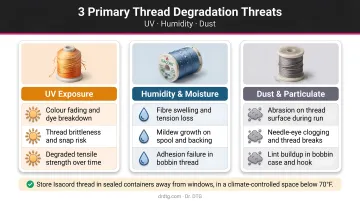
For a small embroidery business, the math is unforgiving. Thread breaks mean machine downtime, rework, wasted stabilizer, and delayed orders. Degraded thread also damages your reputation when a customer receives embroidery with uneven stitching or off-color fills.
Proper storage is largely free. It requires controlled conditions and the right containers—not expensive equipment. A complete, well-organized inventory means you can match colors accurately, reorder by number with confidence, and avoid project delays when a specific shade runs out. Dr. DTG carries the full 390-color Isacord range for exactly that reason.
The Best Storage Methods for Machine Embroidery Thread
No single storage method works for every setup. The right choice depends on collection size, available space, and whether your priority is fast access, dust protection, or portability. Most working embroidery shops use a combination of all three.
Wall-Mounted Racks and Pegboard Systems
Wall racks keep spools visible, off the work surface, and fast to access—a real advantage when switching colors frequently across multi-color designs. Organizing by color family on a wall rack also provides a useful visual reference when selecting thread for new projects.
The trade-off is exposure. Wall-displayed threads face direct light and ambient dust, accelerating fading and brittleness. This method works well only when:
- The storage area has no windows or direct light sources nearby
- A lightweight fabric curtain covers the rack when not in active use
- The threads are high-turnover colors used regularly, not long-term stock
Use wall racks for your 20–30 most active production colors. Reserve longer-term stock for enclosed storage.
Drawer Systems with Dividers
Enclosed drawers solve the light exposure problem entirely. CCI's guidance is clear that closed cabinets and drawers provide complete protection from light and UV—the strongest preservation benefit available without specialized equipment.
Modular drawer units suit collections of 50 spools or more. A few setup details make a big difference:
- Cut foam board dividers, cardboard strips, or use golf tee inserts to hold spools upright
- Orient spools so color labels face outward for fast identification
- Use shallower drawers for standard spools; deeper drawers for mini-king cones
Not all embroidery spools share the same footprint. Isacord 1000m spools measure approximately 4.4 × 7.0 cm, while king cones and 5000m spools are significantly larger. Measure your largest format before purchasing drawer inserts—assuming everything fits a standard spool tray is a common and frustrating mistake.
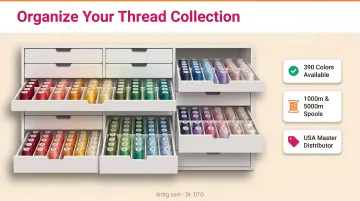
Drawers are particularly effective for bulk polyester thread collections like Isacord, where consistent spool sizing makes organization straightforward.
Sealed Container and Case Systems
Clear, lidded containers offer the strongest combination of dust protection, humidity control, and portability. The ArtBin Super Satchel Thread Box is purpose-built for this use—its 108 pegs hold up to 224 small spools (20mm) or 30 larger spools (45mm), with two removable trays and a latched lid.
Sealed cases are the right choice for:
- Embroiderers who work across multiple locations or teach workshops
- Metallic and specialty threads that need extra moisture protection
- Reserve stock that won't be touched for weeks or months
One materials note worth keeping in mind: conservation research warns against storing textiles in contact with non-acid-free cardboard or colored paper, as dye transfer is a documented risk. Repurposed containers are fine—clear acrylic, stable plastics—but avoid untreated cardboard boxes for anything longer than temporary storage.
How to Protect Machine Embroidery Thread from Environmental Damage
Three factors account for most thread degradation: UV light, humidity, and dust. Get these under control and thread stored properly can last years—Madeira confirms polyester embroidery thread lasts many years when kept cool, dry, and dark. Sulky reports their 40wt rayon remains usable after 35+ years when reasonably protected.
UV and Light Exposure
Light damage is cumulative and irreversible. UV from sunlight and some fluorescent lamps causes photochemical breakdown in fiber structure and dye molecules—the result is faded color and reduced tensile strength. Even polyester thread, which has good UV resilience for outdoor use, will lose vibrancy when stored in open racks near windows over time.
Practical rules:
- Lights should be off in storage areas when not in use
- No racks near windows, skylights, or task lamps
- Cover wall-mounted racks with an opaque fabric curtain between sessions
- Use opaque containers for long-term or backup stock
Humidity and Temperature Control
The Smithsonian Museum Conservation Institute targets 45% RH ± 8% and 70°F ± 4°F for textile collections—conditions that closely align with the 45–55% RH and 65–75°F range recommended for embroidery thread storage.
Precision matters here because humidity fluctuations—not just extremes—cause fiber stress. CCI documents that RH above 70% promotes mold growth, while RH below 40% makes fibers increasingly brittle. A 5°C temperature increase can double the chemical decay rate.
What to do:
- Place silica gel desiccant packs inside any closed storage container or drawer
- Monitor conditions with a small hygrometer (inexpensive, widely available)
- Recharge or replace silica gel when the indicator shows saturation—roughly every 3–6 months depending on your climate
- Avoid storing thread in basements, attics, near HVAC vents, or against exterior walls
Dust and Air Contaminants
Dust in your storage area becomes dust in your thread, and dust in your thread ends up in your machine. Brother's support documentation directly links lint and dust accumulated in the thread tension disc to upper-thread breakage. BERNINA recommends cleaning embroidery machines every 3–4 hours of stitching time specifically because high-speed embroidery generates fine particulate. Covered storage reduces that contamination load before it ever reaches your machine's tension path, needle eye, and cutting system.
For threads not in active daily use, enclosed storage is the default. For wall racks in production areas, a lightweight fabric cover provides meaningful dust protection without slowing down color selection.
Material-Specific Storage Notes
| Thread Type | Key Vulnerability | Storage Priority |
|---|---|---|
| Polyester (Isacord) | UV fading over time | Dark, enclosed, stable RH |
| Rayon | Moisture and age | Sealed containers, test old spools before production |
| Cotton | Light and low humidity | Archival boxes, stable 45–55% RH |
| Metallic (Yenmet) | Moisture and tarnish | Dry, sealed—highest priority for sealed storage |
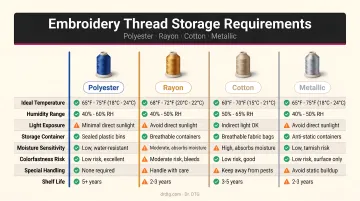
Signs Your Thread Storage System Isn't Working
These warning signs are practical diagnostics — each one points to a specific storage failure worth fixing.
Thread Breakage and Tension Problems
Thread that snaps during a gentle tug test, breaks mid-stitch, or causes erratic tension readings is showing signs of fiber degradation. The most common causes are UV exposure, humidity extremes, or age.
Before adjusting your machine's tension settings or swapping needles, check the thread first — especially if the problem appeared suddenly with a specific spool or color. Every break means stopped machines, rethreading time, and potentially scrapped garments.
Fading, Discoloration, or Odor
Visible color fading, yellowing of white or light-colored threads, or a musty smell are reliable indicators of storage failure:
- Fading/dull sheen → UV or light exposure
- Yellowing → prolonged light exposure or chemical interaction with packaging
- Musty odor → humidity above 70% RH, potential mold
Threads showing these symptoms should be pulled from production use. Running degraded thread through a machine risks color bleed onto fabric and residue transfer into tension components.
Tangling and Unwinding During Storage
Loose thread tails unwinding in storage tangle around neighboring spools and can cause knotting mid-project when the thread has partially unwound inside a drawer. Fix this with:
- Spool huggers (silicone rings) for standard spools
- Thread nets for cones—Allstitch sells pre-cut nets approximately 5¾ inches long, trimmable for smaller spools
- Built-in tension notches on spools that have them
Avoid rubber bands and adhesive tape. Both age poorly and can adhere to fiber surfaces, damaging the thread over time.
How to Organize a Large Thread Collection
Organizing by Brand and Number
Organizing by color family looks great. It's also the system that breaks down fastest once your collection exceeds 100 spools.
The practical system for anyone running production embroidery: organize by brand first, then by manufacturer color number within each brand. This mirrors how thread is sold and referenced in design files. When a spool runs low, you look up the number, go to the supplier's website, and order the exact replacement—no guessing at color names.
Color charts with actual thread samples—not digital swatches—are the most reliable reference tool. Physical swatches like the Isacord Quad-Fold Color Card show real thread beside each color number, which is far more accurate than screen-based matching.
Dr. DTG, as the USA Master Distributor of Isacord Thread, stocks the full 390-color range in both 1000m ($5.29) and 5000m ($9.95) spools, plus pre-curated 50-spool kits like Isacord Kit #4 for embroiderers building out a complete palette.
Labeling and Inventory Rotation
A practical labeling system doesn't need to be complicated:
- Label drawer fronts or container exteriors with the color number range inside (e.g., "Isacord 1000–1999")
- Face spool labels outward so numbers are readable without removing spools
- Maintain a simple spreadsheet tracking quantities and flagging colors below your reorder threshold
- Apply first-in, first-out rotation — new spools go behind or beneath existing stock so older thread is used first
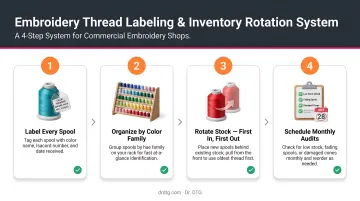
Rotation matters most for cotton and rayon threads, which degrade faster than polyester. For a busy production shop, it's also sound inventory practice—thread that sits too long loses quality before it's ever used.
Frequently Asked Questions
What is the best way to store embroidery threads?
Combine enclosed storage (drawers or lidded containers) with stable environmental conditions—45–55% RH, 65–75°F, and no direct light. Organize by brand and color number so you can retrieve and reorder accurately without guessing.
Does embroidery thread have a shelf life?
There's no fixed expiration date, but thread does degrade. Polyester (like Isacord) lasts many years when stored cool, dry, and dark. Cotton is more time-sensitive—poor conditions like high humidity or direct sunlight can cause brittleness or fading within a year or two.
Should I store machine embroidery thread vertically or horizontally?
Both orientations work. Vertical storage on racks or upright in drawers improves visibility and access. Horizontal storage in flat drawers is better when dust protection is the priority, and works well for skeins or larger cones.
How do I stop embroidery thread from unwinding in storage?
Use spool huggers (silicone rings), thread nets sized for your spool format, or the built-in tension notch if your spools have one. Avoid rubber bands and adhesive tape—they age poorly and can damage fiber surfaces.
What humidity level is best for storing embroidery thread?
Target 45–55% relative humidity. Silica gel packs inside closed containers help maintain this range. A small hygrometer is the easiest way to confirm your storage conditions are where they need to be.
How do I organize embroidery thread by color vs. by number?
Organizing by manufacturer color number (grouped by brand) is more practical for production work—it makes reordering accurate and maps directly to design file references. Color family sorting looks great but gets hard to maintain once your collection exceeds 100+ spools.