Most operators reach for a 75/11 out of habit. That works most of the time. But "most of the time" still leaves significant room for costly failures on knits, sheers, heavy canvas, and specialty threads.
This guide covers the full needle size range, the dual numbering system, point types, and thread pairings — everything needed to make confident, informed needle decisions across all fabric types.
Key Takeaways
- Needle sizes use a dual system: 75/11 = 0.75mm shaft diameter (metric) + US size 11; higher numbers mean thicker needles
- The 75/11 is the industry standard for 40-weight thread on medium-weight fabrics
- Size range runs from 60/8 (ultra-fine fabrics) to 110/18 (heavy upholstery and leather)
- Point type matters as much as size — sharp for wovens, ballpoint for knits, elongated eye for metallics
- Change your needle every ~8 hours of stitching, or immediately when thread shreds or stitches skip
How Machine Embroidery Needle Sizes Are Numbered
Understanding the numbering system eliminates most purchasing confusion before it starts.
The Metric Number (NM)
The first number in any needle designation is the metric size — NM stands for Nadelstärke Metrisch (metric needle strength). According to SCHMETZ, the NM value equals the blade diameter multiplied by 100. So a 75/11 needle has a blade diameter of 0.75mm, and a 90/14 has a blade diameter of 0.90mm. That makes NM a direct physical measurement, not an index or code.
The American Number
The second number (the "11" in 75/11) is the American or Singer classification. SCHMETZ identifies this as older American notation. It's not a direct measurement, but it maps consistently to the metric value — metric 75 corresponds to American size 11, for example.
The core rule is simple: higher numbers on both sides mean a thicker, heavier needle. Madeira confirms that the larger the needle size, the larger the needle and needle eye — which matters when selecting needles for heavier or specialty threads.
Shank Types: Home vs. Commercial Machines
Needle shank type must match the machine type:
- Flat-shank needles — standard for home/domestic embroidery machines; the flat side positions the needle correctly relative to the hook
- Round-shank needles — used in commercial multi-needle machines; Groz-Beckert's DBxK5 system is the standard needle system for single- and multihead commercial embroidery
Using the wrong shank type prevents proper needle seating. Machine manufacturer documentation consistently identifies incorrect needle installation as a direct cause of skipped stitches — always verify shank type in your machine specs before purchasing.
Commercial multi-needle machines like the Xtreme Tech XTPro and Happy Japan series require round-shank needles. Dr. DTG stocks Groz-Beckert needles (75/11 RG and 80/12 KK) compatible with commercial single- and multihead embroidery systems.
The Complete Needle Size Chart for Machine Embroidery
Needle Size by Fabric Weight
| Needle Size | Fabric Types |
|---|---|
| 60/8 – 70/10 | Organza, chiffon, silk, fine batiste |
| 75/11 | Quilting cotton, poplin, satin, medium-weight wovens |
| 80/12 | Canvas, tricot, interlock, slightly heavier wovens |
| 90/14 | Denim, velvet, linen, light wool |
| 100/16 | Heavy denim, corduroy, canvas bags |
| 110/18 | Upholstery, faux fur, thick leather |
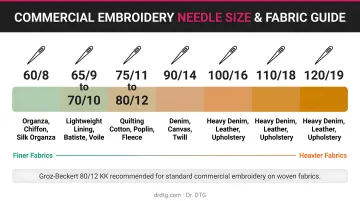
Fabric density drives needle selection, not just fabric type. A heavy canvas shirt needs a larger needle than a lightweight canvas tote made from thinner material — even though both are "canvas."
Needle Size by Thread Weight
Madeira's thread pairing guidance provides the clearest manufacturer-verified reference:
| Thread Weight | Recommended Needle Size |
|---|---|
| 60-weight (fine) | 65/9 – 75/11 |
| 40-weight (standard) | 75/11 |
| 30-weight (bold/thick) | 80/12 – 90/14 |
| Metallic/specialty | 80/12 – 90/14 with specialty eye |
Isacord 40-weight polyester thread — available through Dr. DTG in 390 colors across 1000m and 5000m spools — works with a 75/11 needle in most setups, consistent with Madeira's 40-weight pairing guidance.
The general rule: use the smallest needle that accommodates the thread without resistance. Too large leaves visible holes; too small shreds thread and causes breaks.
Needle Types and Point Styles in Machine Embroidery
Needle size determines how much space the needle occupies in fabric. Point style determines how it interacts with fiber structure. Get either wrong and you'll see thread breaks, fabric distortion, or both.
Sharp Point Needles
Sharp needles pierce and cut through tightly woven fibers cleanly. Use them for:
- Woven fabrics: cotton, linen, denim, canvas, synthetic wovens
- Any application requiring clean fiber penetration without deflection
Ballpoint Needles
Ballpoint needles have a rounded tip that pushes between fibers rather than cutting them. According to Organ/Diamond Needle's technical documentation, this distinction is critical for knit fabrics — cutting through looped knit fibers causes runs, snags, and distortion that no tension adjustment will fix.
Use ballpoint needles for: jersey, interlock, sweatshirt fleece, and spandex blends.
Specialty Needle Types
Metallic needles feature an elongated eye that reduces friction and heat on fragile metallic threads. Diamond Needle's DBx7ST system adds a rectangular-shaped eye that further eases metallic thread passage in commercial applications. Recommended sizes: 80/12 – 90/14.
Leather/wedge-point needles use a cutting wedge tip that slices through leather and vinyl cleanly. Any puncture in leather is permanent — clean hole formation matters. Size range: 80/12 – 100/16 depending on leather weight.
Dedicated embroidery needles have a larger eye and modified scarf geometry that protects specialty threads at high stitch speeds. If you must substitute a universal sewing needle, Hatch Embroidery recommends going up one size to compensate for the narrower eye — for example, use a size 80 sewing needle where you'd normally use a size 70 embroidery needle.
Needle Anatomy and How It Affects Stitch Quality
Each part of the needle performs a specific function. Understanding each part makes it much easier to diagnose stitch problems accurately instead of guessing.
| Part | Function |
|---|---|
| Shank | Attaches to the machine; must match machine type (flat vs. round) |
| Shoulder | Tapered transition from shank to shaft |
| Shaft/Blade | Thickness determines needle size (NM value) |
| Groove | Channels thread to the eye; Groz-Beckert confirms the long groove protects thread from frictional contact during fabric penetration |
| Eye | Opening for thread; embroidery needles have elongated eyes for specialty threads at high speed |
| Scarf | Indentation above the eye; SCHMETZ identifies this as the feature that lets the bobbin hook grab the thread to form a stitch |
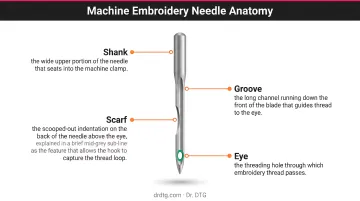
The scarf deserves special attention. At the moment of stitch formation, the scarf creates a small thread loop that the bobbin hook catches. Groz-Beckert's technical documentation confirms that optimized scarf geometry improves loop pickup and reduces skipped stitches, thread breakage, and needle breakage. A worn scarf on an otherwise intact needle disrupts this timing entirely, causing missed stitches that are easy to misdiagnose as tension problems.
Using the Wrong Needle: Consequences and Common Mistakes
Needle mismatch causes most embroidery machine problems that operators blame on tension settings, thread quality, or machine calibration. The failure modes are predictable:
| Needle Error | Result |
|---|---|
| Needle too large | Visible holes, fabric damage on delicate materials |
| Needle too small | Thread shredding, frequent breaks, tension irregularities |
| Sharp needle on knits | Fiber cutting, runs, distortion |
| Ballpoint on dense wovens | Blunt fiber tearing, uneven stitch formation |
| Wrong needle for metallic thread | Excessive friction, fraying, constant breaks |
The most common misinterpretation is treating the 75/11 as a universal needle. It is the right choice for 40-weight thread on medium-weight wovens — but it fails predictably on knits (needs ballpoint), lightweight sheers (needs 65/9–70/10), and heavy materials (needs 90/14 or larger).
Size recommendations are starting points, not absolutes. Real-world factors — stitch density, embroidery speed, stabilizer type, garment construction — each affect needle performance differently. Run a test swatch first; a single misjudged needle choice on 500 caps costs far more than a five-minute scrap test.
Needle Maintenance and Troubleshooting
A fresh needle costs less than one minute of wasted production time. Yet it's one of the most skipped steps in a busy shop.
Knowing when to change — and what symptoms to watch for — keeps your output consistent and your machine running clean.
Change Frequency
Madeira recommends changing embroidery needles after approximately 8 hours of stitching under standard conditions. Change immediately when:
- Thread shreds or breaks repeatedly
- Stitches are skipping
- Fabric shows unexpected snags or damage
Troubleshooting by Symptom
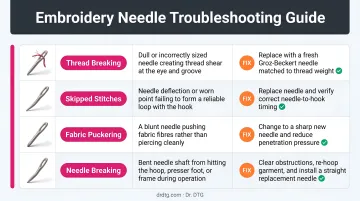
- Thread breaks — Check whether the eye is large enough for the thread; heavier or metallic threads need larger eyes and grooves
- Skipped stitches — Inspect the scarf for wear; verify the needle is fully seated with the flat side facing the back (for home machines)
- Fabric snags or unexpected holes — Verify correct point type for the fabric; check for a damaged needle tip
- Uneven tension — Confirm needle size matches the thread weight; a mismatch creates uneven thread path tension and inconsistent stitch quality
Frequently Asked Questions
What is the most common needle size for machine embroidery?
The 75/11 is the industry standard : it works for most 40-weight threads on medium-weight fabrics and is what Madeira identifies as the ideal all-purpose size for commercial embroidery. Substitute it only for especially light, heavy, or specialty materials.
What needle size should I use for 40-weight embroidery thread?
The 75/11 is the verified match for 40-weight thread, including Isacord. A quick field check: thread should pass through the eye with minimal resistance. If it drags noticeably, size up.
What is the difference between a sharp and ballpoint embroidery needle?
Sharp needles pierce woven fibers cleanly; ballpoint needles push between knit fibers without cutting them. Using the wrong point type doesn't just affect appearance. It physically damages fiber structure in ways that can't be corrected after the fact.
How often should I change my embroidery machine needle?
Every 8 hours of stitching for standard use, per industry guidance. Replace immediately when symptoms appear: thread fraying, skipped stitches, or unusual resistance when the needle enters fabric.
Can I use regular sewing machine needles for machine embroidery?
Yes, but with trade-offs. Sewing needles have a smaller eye and different scarf geometry that increases thread breakage risk. If you use one, go up one size to compensate for the narrower eye.
What needle size is best for embroidering on knit fabrics like t-shirts?
A 75/11 ballpoint for most knit garments. The point style matters more than the size number for knits: the rounded tip prevents the fiber cutting that causes runs. For heavier knits like sweatshirt fleece, step up to an 80/12 ballpoint.