This guide breaks down what determines how long a DTG print actually lasts — covering the realistic lifespan range, the production factors that matter most, proper care practices, and how DTG compares to other methods. Whether you're a customer wanting to protect a favorite shirt or a business owner setting expectations with clients, this is the information you need.
Key Takeaways
- Well-executed DTG prints on 100% cotton can last 50 to 100+ wash cycles — often as long as the garment itself
- Pretreatment and curing determine durability more than the print method itself
- 100% cotton delivers significantly better ink adhesion than polyester blends
- Cold water, gentle cycles, and air drying extend print life considerably
- DTG offers comparable durability to screen printing with far superior detail for complex designs
How Long Do DTG Prints Last?
The "50-wash myth" creates unnecessary confusion. Ricoh DTG identifies 50 washes as an industry-cited benchmark for printed clothing — but also notes that properly finished DTG prints tend to last the life of the garment. Those two statements don't contradict each other. Fifty washes is a floor for acceptable performance, not a ceiling for what DTG can achieve.
Brother's GTXpro Innobella Textile inks scored 4.0 or higher on AATCC wash tests, which is the same standardized testing used across the textile industry. Meanwhile, Kornit notes that high-quality machines and proper workflows produce prints lasting through dozens of washes, while poor curing or incorrect pretreatment can cause fading after just a few cycles.
What "Lasting" Actually Means
A DTG print that "lasts" doesn't mean zero visible change after 100 washes. Gradual, subtle fading is normal across every print method — screen printing, heat transfer, dye sublimation included. Print failure is something different: cracking, peeling, color washing out completely, or design integrity breaking down within the first dozen washes.
That kind of failure comes from poor production decisions, not from DTG as a technology. What happens before and during printing determines how long a print holds up:
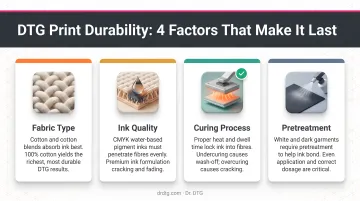
- Fabric choice — higher cotton content holds ink better
- Pretreatment — improper application leads to early fading
- Ink quality — commercial-grade inks outperform budget alternatives significantly
- Curing — under-cured prints begin breaking down after just a few washes
Key Factors That Affect DTG Print Durability
Fabric Composition
Fabric is the single biggest variable most buyers don't think about. Epson recommends 100% cotton with thick, tightly woven ringspun material for best DTG results, and the chemistry explains why: pigment inks don't chemically bond to cotton on their own. They rely on binders to form a resin matrix that traps pigment particles within the fiber structure. Cotton's natural composition allows this matrix to form more effectively than synthetic alternatives.
For best results, prioritize:
- 100% ringspun cotton — allows binder matrix to form fully within the fiber
- Heavyweight blanks (5.5 oz+) — fabric degrades more slowly, extending print life
- Tight weave construction — less surface irregularity means more even ink adhesion
- Avoid high polyester blends — ink sits on top of the fiber rather than integrating, increasing wash friction damage
Polyester and synthetic-heavy blends absorb ink less effectively, which translates to more subdued colors and shorter print life. A thin, low-grade blank will wear out — physically and aesthetically — well before a quality heavyweight cotton shirt does.
Ink Quality
Professional-grade, water-based pigment inks bond to fabric through a binder chemistry process where crosslinking agents increase durability and enhance wash fastness. DuPont describes their Artistri DTG inks as water-based pigment formulations that, when paired with proper pretreatment, produce wash-resistant prints with high durability.
Cheap or incompatible inks compromise this chemistry. No amount of perfect curing or ideal fabric will compensate for ink that wasn't formulated for textile DTG applications.
White underbase inks — used on dark garments — deserve special attention. They must maintain opacity and vibrancy through repeated washing, which demands particularly robust formulation. This is where cut-rate inks show their weaknesses fastest.
Printer Quality and Settings
The machine itself affects output consistency. Printers with precise ink delivery, reliable head alignment, and well-calibrated pressure settings produce prints that adhere uniformly across the entire design area. Inconsistent machines produce inconsistent adhesion — meaning some areas of a print may hold while others fade prematurely.
For businesses investing in DTG equipment, machine quality is a durability input, not just a productivity one. Dr. DTG has sold and serviced DTG printers for over 20 years, and the machines they carry include a 5-year warranty — reflecting how seriously equipment longevity factors into print quality over time. Call 714-770-0969 to discuss which machine fits your production volume.
The Critical Role of Pretreatment and Curing
These two steps determine more about DTG print longevity than almost anything else — and they're where most failures originate.
Pretreatment
Pretreatment is a liquid solution applied to the garment before printing. It creates a chemically prepared surface that allows ink to bond properly to the fibers. Without it, especially on dark or colored fabrics:
- White ink soaks into the fabric instead of sitting on the surface
- CMYK colors appear dull and washed out
- Adhesion fails, causing peeling or rapid fading within just a few washes
Epson specifies approximately 0.5 oz / 15g of pretreatment for a standard Letter/A4 print area. Consistency of application matters as much as quantity — uneven manual spraying creates patchy coverage, which leads to weak adhesion in undertreated areas. Automatic pretreat machines apply solution more evenly across every garment, taking that inconsistency out of the equation.
Curing
After printing, the garment must be heat-cured — either with a heat press or conveyor dryer — at precise settings. Under-curing is the most common production failure:
- Brother states under-curing can cause ink breakdown and cracking after just one wash and dry cycle
- Epson notes insufficient fixation allows colors to wash out or rub off
- Over-curing causes its own problems: cracked ink, scorched fabric, or prints that look thin and faded
Typical curing benchmarks from manufacturers:
| Printer | Heat Press Temp | Dwell Time | Conveyor Temp |
|---|---|---|---|
| Epson F2270 (color ink) | 338°F | 45 sec | 320°F, 3.5-5 min |
| Epson F2270 (white ink) | 338°F | 90 sec | 320°F, 5 min |
| Brother GTXpro | 356°F | 35 sec | 320°F, 3.5-5 min |
| Ricoh Ri 4000 | ~280°F | 30 sec | — |
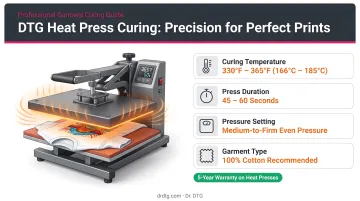
A properly cured print feels fully set and smooth to the touch, with no tackiness or rubbery texture. Before committing to a full production run, run a sample wash test after dialing in your curing settings — it's the most reliable way to confirm everything is dialed in correctly.
How to Wash and Care for DTG Printed Shirts
Even a perfectly produced DTG print will fade faster with poor care habits. Follow these guidelines to get the most life out of every print:
Washing:
- Turn the garment inside out before washing — reduces direct friction on the print
- Use cold water only; hot water accelerates ink breakdown
- Select a gentle or delicate cycle
- Use mild, dye-free detergent; fragrances and enzymes can degrade ink over time
What to avoid:
- Bleach (degrades both ink and pretreatment layer)
- Fabric softeners (coat fibers in ways that affect ink adhesion over time)
- Harsh stain removers
Drying:
- Air drying is the safest option for print longevity
- Low-heat dryer settings are acceptable for convenience
- High-heat tumble drying is one of the fastest ways to shorten a DTG print's life
- Never iron directly on the printed area; iron inside-out or use a pressing cloth instead
DTG vs. Other Printing Methods: A Durability Comparison
| Method | Wash Durability | Key Strength | Key Limitation |
|---|---|---|---|
| DTG | 50–100+ washes (with proper production) | Full-color detail, soft hand feel, no raised layer | Highly dependent on fabric, pretreatment, curing, and care |
| Screen Printing | 100+ washes (properly cured plastisol) | Extremely durable on bold, simple designs | Not cost-effective for small runs or photographic prints |
| Heat Transfer Vinyl (HTV) | ~50 washes (product-specific) | High opacity, good for solid-color designs | Prone to cracking/peeling, especially on stretch fabrics |
| Dye Sublimation | Essentially permanent on polyester | Color becomes part of the fiber — won't peel | Requires polyester; not viable for cotton garments |
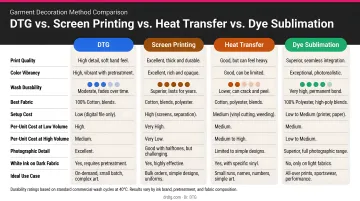
For full-color or photographic designs on cotton, DTG is the most practical option — screen printing edges it slightly on raw durability, but only for bold, simple artwork where setup costs are justified by large order volumes. If you're printing short runs with complex artwork, DTG's wash durability is more than sufficient, and you avoid the setup overhead entirely. Dye sublimation wins on permanence, but only if your blanks are 100% polyester.
Frequently Asked Questions
How durable is direct to garment printing?
DTG printing is highly durable when produced correctly. Well-executed prints on 100% cotton with proper pretreatment and curing can last 50 to 100+ washes — often outlasting the garment itself. Early print failure comes down to poor production quality, not the technology itself.
Does DTG printing fade after washing?
Gradual fading is normal with any print method — it's not the same as print failure. Properly produced DTG prints hold their vibrancy through many wash cycles. Hot water, harsh detergents, and high-heat drying are the habits that speed up visible fading.
Is DTG printing more durable than screen printing?
Screen printing has a slight edge in raw wash durability on simple, bold designs, but properly produced DTG prints offer comparable longevity. For complex, multi-color, or photographic designs, DTG is the stronger choice — the durability difference is minimal, and the design flexibility is far greater.
Does fabric type affect how long a DTG print lasts?
Yes — fabric is one of the biggest durability variables. 100% cotton delivers the best ink adhesion and longest print life. Polyester and synthetic blends absorb ink less effectively, resulting in shorter print life and less vibrant results from the start.
Can you put DTG printed shirts in the dryer?
Low-heat dryer settings are acceptable, but air drying is the safest option for maximizing print life. High-heat tumble drying is one of the most common causes of premature DTG print degradation — the heat breaks down ink bonds much faster than natural drying.
How does pretreatment affect DTG print durability?
Pretreatment is essential for ink adhesion, particularly on dark garments. Without it, white ink soaks into the fabric rather than bonding to the surface, and the print will fade or wash out quickly regardless of how well everything else was executed.