DTG printing sits at the center of this shift. It's one of the most talked-about technologies for entrepreneurs entering the custom apparel space, and for good reason. But the technology that looks impressive in demos behaves differently when you're fulfilling real orders, managing ink costs, and scaling a business.
This guide breaks down exactly what DTG printing is, what it genuinely does well, where it falls short, and how to decide whether it fits your business model.
Key Takeaways
- DTG uses modified inkjet technology to apply water-based ink directly onto fabric — no screens, no transfers
- Strengths: photorealistic quality, no order minimums, minimal setup, water-based inks
- Limitations: high equipment cost, best on cotton only, poor economics for large identical runs
- Best fit: on-demand fulfillment, e-commerce brands, custom or short-run printing
- Wrong fit: bulk production of identical garments, performance or synthetic fabrics
What Is DTG Printing?
DTG (Direct to Garment) printing uses a specialized inkjet printer to apply water-based ink directly onto a garment's fabric surface. No transfer paper. No screens. A digital file goes in, a printed garment comes out.
Kornit Digital defines DTG as a textile printing method that prints directly onto fabric rather than using heat transfer or dye sublimation. Brother describes the process as sending full-color designs from a computer directly to a printer with a garment loaded into it — essentially inkjet printing adapted for fabric.
Common applications include:
- Custom t-shirts, hoodies, and tote bags
- Limited-edition or one-off designs
- Personalized garments for individual orders
- Small-batch runs for events, brands, or retail
DTG is most effective on cotton and cotton-blend fabrics, where water-based inks absorb well into natural fibers. Newer systems have extended capability to some polyester blends, but cotton remains the optimal substrate.
For entrepreneurs and custom apparel businesses, that fabric limitation is worth understanding upfront — but it doesn't diminish DTG's core advantage: the ability to fulfill custom orders one at a time, with no large inventory commitment and no per-job screen setup costs.
Key Advantages of DTG Printing
Each advantage below has a direct operational or business payoff — not just a better-looking shirt.
Photorealistic Quality with No Design Complexity Limits
Screen printing requires a separate screen for every color in a design. DTG doesn't. A digital file — regardless of how many colors, gradients, or fine details it contains — prints the same way every time.
In practice: a customer submits a full-color photograph, a complex illustration, or a design with subtle shadows and soft edges. The file loads into RIP software, the printer applies ink precisely onto the garment, and the result is a reproduction that would be cost-prohibitive or technically impossible with screen printing.
Operationally, this means:
- No color-separation cost, regardless of artwork complexity
- Businesses can accept any design a customer provides without charging extra for color count
- Artists and designers can sell work exactly as created, not simplified for print compatibility
Millennials and Gen Z account for nearly two-thirds of custom t-shirt purchases, with apparel tied to self-expression and often commanding premium pricing. Print quality and design variety aren't just nice to have — they're a competitive differentiator.
No Minimums and Low Per-Job Setup
Screen printing requires screen preparation before a single shirt is printed. DTG requires almost none. One garment is as easy to set up as ten. That changes the economics of small-batch and single-unit fulfillment entirely.
This is what makes print-on-demand (POD) business models viable at scale. A customer orders one shirt on an e-commerce platform, the file routes directly to the printer, the garment ships — no pre-held inventory required.
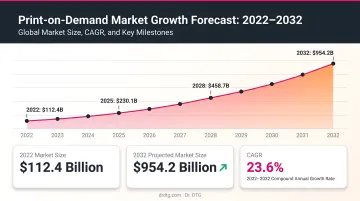
The global print-on-demand market was $6.4 billion in 2022 and is projected to reach $64.3 billion by 2032, growing at 26.4% annually. Online direct-to-consumer platforms held 61.4% of custom t-shirt revenue in 2025.
For e-commerce brands, Etsy sellers, and early-stage entrepreneurs, this eliminates the biggest early-stage risks:
- Minimum order quantity (MOQ) requirements
- Upfront inventory investment
- Risk of unsold stock
- Delayed launch while waiting for bulk production
Eco-Friendly Water-Based Inks
DTG printers use water-based pigment inks rather than the plastisol inks common in screen printing. Plastisol is PVC-based. Water-based inks avoid the solvent and VOC exposure associated with traditional printing chemistry, and they produce less chemical waste per garment.
The business case goes beyond environmental ethics:
- Younger buyer appeal: About 40% of Gen Z and millennial consumers say environmental impact is an extremely or very important purchasing factor — nearly double the rate for Baby Boomers
- Premium pricing signal: Research from Bain found 84% of sustainability-focused consumers will pay more for sustainably produced products
- Regulatory headroom: Fewer chemicals in the production process reduces compliance exposure, particularly for businesses in markets with tighter textile production standards
Water-based inks are also safer for children's apparel and sensitive skin — a practical edge for brands in those categories.
Key Limitations of DTG Printing
DTG is a capable technology. But it comes with operational constraints that affect profitability and scalability if you don't plan for them before purchasing.
High Equipment Cost and Ongoing Maintenance
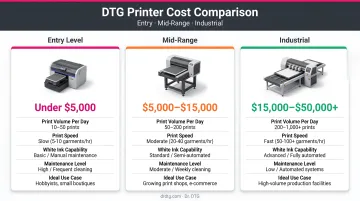
Commercial DTG printers are a real capital investment. Verified pricing from Epson's current lineup:
| Tier | Model | MSRP |
|---|---|---|
| Entry commercial | Epson SureColor F1070 | $4,995 |
| Mid-range commercial | Epson SureColor F2270 | $12,995 |
| Industrial | Epson SureColor F3070 | ~$49,995 |
Equipment cost is only part of the picture. Ongoing costs include ink cartridges, pretreatment solution, maintenance supplies, and occasional repair or downtime. Print heads can clog when machines sit idle — requiring regular cleaning cycles whether you're printing or not.
DTG equipment makes sense when print volume is consistent enough to spread those fixed and recurring costs across a meaningful number of garments. Low-volume shops face the same maintenance demands as high-volume ones.
Fabric Restrictions — Best Results on High-Cotton Content
DTG water-based inks bond with natural fibers. On synthetic fabrics, that bond weakens.
Polyester fibers have a flat, smooth surface that doesn't absorb water-based ink the way cotton does.
On 50/50 blends, Brother's own technical documentation notes that lower cotton content reduces pretreatment absorption capacity — which can cause white ink to sink through rather than hold on the surface.
Practical impact by fabric type:
- 100% cotton: Optimal results, vibrant color, reliable consistency
- High-cotton blends (80%+): Generally strong results with proper pretreatment
- 50/50 blends: Requires special handling, variable results
- Polyester / synthetics: Muted, inconsistent output — DTG isn't the right tool here
For businesses that want to expand into performance wear, swimwear, or athletic fabrics, DTG has a ceiling. Serving those categories typically requires adding a second printing technology.
Fabric composition isn't the only variable. Dark garments also require pretreatment — a chemical solution applied before printing — to help white ink adhere. Uneven application produces uneven prints, so consistent technique matters every run.
Not Cost-Effective for Large Production Runs
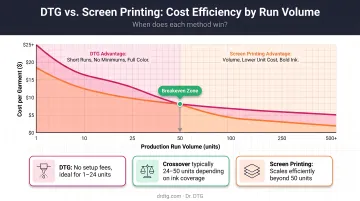
DTG's setup advantage works in reverse at volume. Screen printing becomes more economical when setup costs are spread across hundreds of identical units. DTG's per-unit cost doesn't decrease meaningfully at higher quantities.
Every garment takes roughly the same amount of time to print, whether it's the first garment or the five-hundredth. The Brother GTXpro B can print up to 57 light garments per hour and 42 dark garments per hour in high-speed mode — capable, but finite. At scale, that time adds up fast.
The scaling reality: a brand that starts on-demand and grows to needing 500+ identical shirts per run will likely find screen printing significantly more economical per unit. DTG shops that hit that ceiling typically add screen printing capacity, raise minimums, or reprice to protect margins.
Is DTG Printing Right for Your Business?
The honest answer depends on three variables:
- Order profile — Are orders mostly small, varied, and custom? Or large, uniform, and repeated?
- Fabric mix — Is your product line primarily cotton-based, or do you need to print on synthetics?
- Capital structure — Are you ready to invest in equipment, or does it make more sense to use a printing service while validating demand?
Once you've mapped your order profile and fabric mix to those three variables, the fit becomes clearer.
DTG fits well when:
- You're launching a print-on-demand or e-commerce brand
- You sell personalized, one-off, or limited-edition designs
- Your orders are typically under 50 units and highly varied
- Your garments are cotton or high-cotton blends
DTG fits poorly when:
- You're producing 500+ identical shirts per run
- Your product line includes performance wear or synthetic fabrics
- You need extremely low per-unit cost at high volume
If you're still weighing whether to invest in your own DTG printer or start with a printing service, Dr. DTG offers both. With over 20 years in garment printing, their team can walk you through equipment options, explain what warranty coverage actually covers, and take on printing jobs for businesses not yet ready to own a machine. Call 714-770-0969 or email info@drdtg.com to get specific answers for your setup.
How to Maximize Your DTG Results
Getting consistent, professional output from a DTG printer comes down to discipline in three areas:
Pretreatment:
- Apply evenly on all dark garments — uneven application causes uneven prints
- Use the correct pretreatment formula for your fabric content
- Cure the pretreatment properly with a heat press before printing
File and software preparation:
- Design files should be prepared at the correct resolution for your printer's RIP software
- Use the appropriate color profile — what looks correct on screen may not match fabric output without calibration
- Test new designs on sample garments before fulfilling customer orders
Machine maintenance:
- Run cleaning cycles on a consistent schedule — don't wait for print quality to degrade before acting
- Don't let machines sit idle for extended periods without maintenance
- Monitor print output regularly and act on color drift or quality inconsistencies immediately
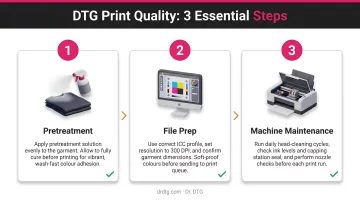
Shops that produce reliable DTG work tend to treat these three areas as non-negotiable — not as checklists to revisit when something goes wrong.
Conclusion
DTG printing offers real advantages for entrepreneurs building custom or on-demand apparel businesses — print complex designs without minimums, hold zero inventory, and use cleaner water-based inks. But those advantages only hold when the technology is matched to the right use case.
High equipment cost, fabric limitations, and per-unit economics at scale are genuine constraints. Ignore them in your pricing and business plan, and they'll surface later as margin problems.
The businesses that make DTG work aren't the ones who discovered it was a good fit — they're the ones who confirmed it was a good fit before committing. If you're still working through that decision, the Dr. DTG team has spent over 20 years helping shops match the right printing equipment to the right business model.
Frequently Asked Questions
What are the advantages and disadvantages of DTG printing?
DTG's main advantages are photorealistic print quality with no color-count limitations, no minimum order requirements, and water-based inks with lower chemical waste. The main drawbacks are high upfront equipment cost, best results limited to cotton or high-cotton fabrics, and higher per-unit cost compared to screen printing on large identical runs.
Which lasts longer: DTG or DTF printing?
Both methods produce durable prints when properly cured. DTG ink bonds into fabric fibers for a softer feel but can fade faster with heavy washing; DTF transfers sit on top with an adhesive layer that tends to be more stretch- and wash-resistant. Either way, cold water, inside-out washing, and no high heat drying will extend the life of the print.
What fabrics work best with DTG printing?
100% cotton and high-cotton blends (80%+ cotton) deliver the best results because water-based DTG inks bond most effectively with natural fibers. Polyester and synthetic fabrics produce less vibrant, less consistent output and are generally not well-suited for DTG printing.
Is DTG printing good for small businesses?
DTG is well-suited for small businesses and startups because it requires no minimum order quantities, eliminates inventory risk, and enables fast turnaround on custom orders. It's a natural fit for print-on-demand e-commerce where orders are small, varied, and need to ship quickly.
How much does a DTG printer cost?
Commercial DTG printer prices range from around $4,995 for an entry-level machine (Epson SureColor F1070) to $12,995 for mid-range (Epson SureColor F2270) and approximately $49,995 for industrial units (Epson SureColor F3070). Factor in ongoing costs — ink, pretreatment supplies, and maintenance — when calculating total investment.
Does DTG printing require pretreatment?
Pretreatment is required for dark-colored garments — a chemical solution applied before printing helps white ink adhere and keeps colors vibrant. It adds a step to the workflow, but it's essential for consistent quality on anything other than white or light-colored garments, and uneven application directly causes uneven results.