Introduction
A commercial embroidery machine has dozens of moving parts running in sync at high speed, stitch after stitch. Keep that system well-maintained and it produces consistent output reliably for years. Let it slide, and small issues turn into costly ones faster than most operators expect.
Neglected machines show up in predictable ways: thread breaks mid-run, stitches skip, birdnesting tangles beneath the fabric, tension goes erratic.
For embroiderers running a business, each of these issues means wasted materials, delayed orders, and frustrated customers — problems that routine care would have prevented entirely.
This guide covers the core maintenance tasks, warning signs to watch for, a practical scheduling framework, and guidance on when to call in professional support — so your machine stays running when it needs to.
Key Takeaways
- Preventive maintenance prevents costly breakdowns — skipping it is how small issues become expensive repairs
- Core tasks include daily rotary hook oiling, routine cleaning, and periodic needle replacement
- Warning signs include thread breaks, unusual noise, skipped stitches, and birdnesting
- High-volume shops should oil every 4–5 hours of use; occasional users can follow a monthly schedule
- Persistent issues after basic maintenance call for professional service — don't wait
Why Embroidery Machine Maintenance Matters
Embroidery machines aren't forgiving of neglect. A dry rotary hook, a worn needle, or lint packed around the bobbin area each create friction and inconsistency — and those small failures cascade. One degraded component puts stress on adjacent parts.
The Output Impact
The clearest sign of a maintenance gap is declining stitch quality. According to Brother's PR-series manuals, thread breaks and loud hook noise are direct indicators that the race hook needs oiling. Melco's troubleshooting documentation similarly lists inadequate lubrication and maintenance as a primary cause of thread-break errors. The output-level symptoms — skipped stitches, birdnesting, uneven tension — are documented, predictable consequences of deferred care.
The Financial Case
The cost difference between preventive and reactive maintenance is measurable — and it favors prevention by a wide margin. NIST's manufacturing maintenance research found that establishments relying on preventive and predictive maintenance had 52.7% less unplanned downtime and 78.5% fewer defects than those running reactive programs. While that data covers manufacturing broadly, the principle applies directly to embroidery equipment: preventive maintenance costs (oil, needles, cleaning supplies) are a fraction of what a repair or part replacement runs.
The Business Continuity Angle
Whether you run a single-head shop or a multi-head commercial operation, unplanned downtime hits your revenue directly. Missed deadlines damage client relationships. Rushed repairs cost more than scheduled maintenance. A simple maintenance schedule — covered in the sections below — is the lowest-cost insurance you have against both.
Types of Embroidery Machine Maintenance
Not all maintenance tasks are the same — they differ in timing, purpose, and who performs them.
Preventive / Routine Maintenance
Preventive maintenance is the foundation: scheduled tasks performed before problems develop.
Cleaning
Daily cleaning prevents the most common source of machine issues — debris accumulation. After each session (or daily in high-volume shops):
- Remove lint, thread trimmings, and dust from the bobbin area and shuttle bed
- Use a soft brush to clear around the needle plate
- Apply compressed air in short bursts for hard-to-reach areas
- Check scissor blades for thread buildup
Skipping this allows debris to contaminate the hook area, cause jams, and accelerate wear on precision surfaces.
Oiling
Oiling keeps friction low across all the machine's moving parts. Key reference points from manufacturer documentation:
- Rotary/bobbin hook: Daily before use (Brother PR-series manuals); every 4–5 hours of solid running for high-volume commercial use (Melco EMT16X technical manual)
- Lower needle bar: Every 40–50 hours (Brother PR1055X and PR680W manuals)
- Needle bars (all): Every two weeks under frequent use (Janome MB-7)
- Cams and gear drives: Grease (not oil) approximately every 6 months
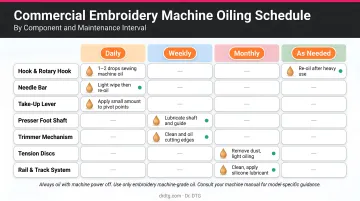
Always use the lubricant type specified for your machine. Brother manuals state that any oil other than machine oil may damage the machine. Melco specifies SAE 5 sewing machine oil and warns that incorrect lubricants can shorten component life and void the warranty.
When in doubt, check your machine's manual — don't substitute household products.
Needle Replacement
Needles degrade faster than most users expect. Madeira's needle guide cites an approximate 8-hour average needle life for commercial embroidery machine use. Replace needles:
- Monthly or quarterly under regular use
- Immediately if thread breakage increases, stitching quality drops, or the needle shows visible bending or burring at the tip or eye
- At the start of any significant new project as a baseline
Dr. DTG stocks Groz-Beckert 80/12 KK needles — suited for both knit and woven fabrics, appropriate for single and multi-head commercial embroidery.
Thread Quality as a Maintenance Factor
Thread quality directly affects how often you need to clean. Poor-quality thread produces more lint, increases breakage, and contaminates the hook area faster.
Isacord — a 40-weight trilobal polyester thread from AMANN in Germany — is engineered for high-speed commercial embroidery with nearly twice the strength of rayon and a documented design goal of eliminating thread breaks. Dr. DTG is the USA Master Distributor of Isacord, carrying the full 390-color catalog in 1000m and 5000m spools.
Using thread built for commercial machines keeps the machine cleaner between maintenance sessions.
Corrective / Reactive Maintenance
Corrective maintenance addresses problems after they've already occurred. Every embroidery shop deals with this occasionally, but relying on it as a primary strategy is expensive. Skipped preventive care creates a cascade:
- A worn needle damages the needle plate if not replaced promptly
- A jam cleared incorrectly can pull the machine out of timing
- One deferred fix typically creates two more repair tasks
Professional / Overhaul Maintenance
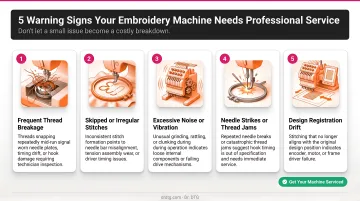
Some issues require more than oil and a cleaning brush. Schedule professional service when:
- DIY maintenance no longer resolves recurring thread breaks or tension problems
- Internal timing is off (stitches are consistently misaligned despite correct setup)
- Unfamiliar mechanical sounds — grinding, clicking, or abnormal vibration — persist
- The machine displays a maintenance message (Brother's manuals specifically recommend taking the machine to an authorized dealer when this message appears)
- As a scheduled annual deep-service for high-volume machines
Dr. DTG provides embroidery machine repair services across the USA — on-site for Southern California customers, and return-to-depot service for other states. Having a trusted repair resource before you need it urgently is part of sound machine ownership.
Warning Signs Your Embroidery Machine Needs Maintenance
Some maintenance needs are predictable (you know when you last oiled the hook). Others announce themselves through the machine's behavior.
Output-based warning signs:
- Increased thread breaks — especially if rethreading doesn't resolve them
- Skipped or uneven stitches across a run
- Birdnesting (thread tangling beneath the fabric near the bobbin)
- Inconsistent tension — bobbin thread pulling to the top or top thread looping underneath
- Staining on embroidery (often from excess or contaminated oil)
Mechanical and behavioral warning signs:
- Louder-than-normal hook operation (a direct indicator from Brother's manuals that oiling is needed)
- Grinding or clicking sounds during a run
- Sluggish needle bar movement or hesitation mid-stitch
- Machine stopping unexpectedly without an obvious cause
- Error messages on the display — especially maintenance prompts
Frequency-based warning signs:
If the same issue keeps recurring — thread breaks after rethreading, repeated jams, persistent tension problems — you've either delayed routine maintenance too long, or something mechanical needs a technician. One-off issues are usually self-correcting. Recurring ones aren't: schedule a service call before the problem compounds into a longer (and more expensive) repair.
Embroidery Machine Maintenance Schedule
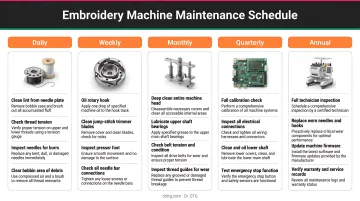
Maintenance frequency scales with how hard the machine works. A lighter-use shop running a few hours per week has different needs than a high-volume operation running eight or more hours daily. Use this as a general framework and adjust based on your machine's manual.
| Interval | Task |
|---|---|
| Daily / Before each use | Oil the rotary hook (1 drop); clean bobbin area and lint from needle plate; test stitch on scrap fabric after oiling |
| Every 4–5 hours (commercial use only) | Re-oil rotary hook during extended production runs |
| Every 40–50 hours | Oil lower needle bar (Brother PR models); check for lint in thread paths |
| Weekly | Oil all needle bars and color slots; compressed air cleaning of hard-to-reach areas; inspect thread guides for burrs or wear |
| Monthly | Replace or inspect needles; clean exterior and touchscreen; thorough check of thread paths and tension guides |
| Semi-annual / Annual | Grease cams and gear drives; inspect and check drive belts; schedule professional inspection for high-volume machines |
Usage-based notes:
- High-volume (8+ hours/day): Increase rotary hook oiling to every 4–5 hours per Melco's EMT16X specifications. Consider a brief cleaning pass between color changes on long runs.
- Intermittent use: Store the machine covered in a dust-free area. Before resuming after a period of inactivity, apply fresh oil and run a test stitch on scrap fabric before starting production work.
Conclusion
Regular maintenance is what protects the investment. An embroidery machine that's consistently cleaned, oiled, and inspected runs more accurately, produces better output, and lasts far longer than one that only gets attention when something goes wrong.
Build a schedule that fits your usage pattern and stock the basics:
- Lightweight sewing machine oil
- Appropriate grease for your machine's cams and drives
- Replacement needles
- A good cleaning brush
Use quality thread to reduce lint buildup between sessions. When problems persist beyond routine care, bring in a technician before a minor issue becomes a costly repair.
Dr. DTG's repair team is available for commercial embroidery machine service across the USA. Contact them at 714-770-0969 or info@drdtg.com.
Frequently Asked Questions
How much does an embroidery machine service cost?
Routine supplies (oil, needles, cleaning tools) are inexpensive. Professional servicing varies more widely — one repair shop lists single-head embroidery machine service at $209.99 and multi-needle service at $499.99, though final costs depend on the provider, machine type, and whether parts or travel are involved.
What general maintenance does an embroidery machine need?
The core tasks are daily oiling of the rotary hook, regular cleaning of lint and debris from the bobbin area and needle plate, periodic needle replacement, and occasional grease application to cams and gear drives — all following the manufacturer's specifications for your specific model.
How often should an embroidery machine be serviced?
Light users should follow monthly maintenance checks with annual professional servicing. Commercial and high-volume users should oil the rotary hook daily (or every 4–5 hours of continuous use) and schedule professional inspections more frequently, especially for machines running 8+ hours per day.
What type of oil should I use for my embroidery machine?
Lightweight, clear sewing machine oil is standard for most oil points — Melco specifies SAE 5 weight for their machines. Synthetic grease (medium to high viscosity, heat-resistant) is used for cams and gear drives. Always follow your machine's manual. Avoid substituting household oils or any product not specified for sewing machine use.
How do I know when to replace embroidery machine needles?
Replace immediately if the needle is visibly bent, burred at the tip or eye, or if stitching quality drops or thread breakage increases unexpectedly. Monthly or quarterly replacement under regular use keeps performance consistent. Madeira cites approximately 8 hours of commercial use as an average needle lifespan.
Can I perform embroidery machine maintenance myself, or do I need a professional?
Daily and weekly tasks — oiling, cleaning, needle changes — are manageable for most users with the machine manual in hand. Timing problems, unfamiliar noises, or recurring faults that basic maintenance doesn't resolve should go to a professional promptly.