This guide compares both brands on the specs that drive business outcomes for shops scaling production or stepping toward multi-head: price transparency, package value (caps/hoops included vs add-on), warranty and certified repair access, ease of operator training, and path from single-head to multi-head.
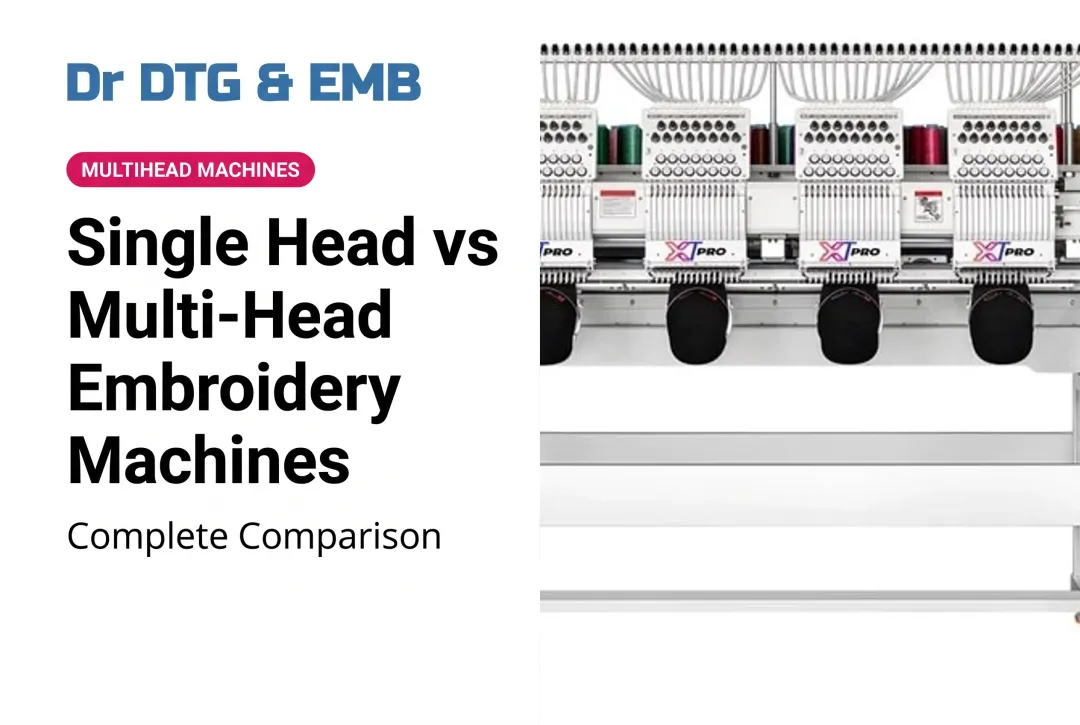
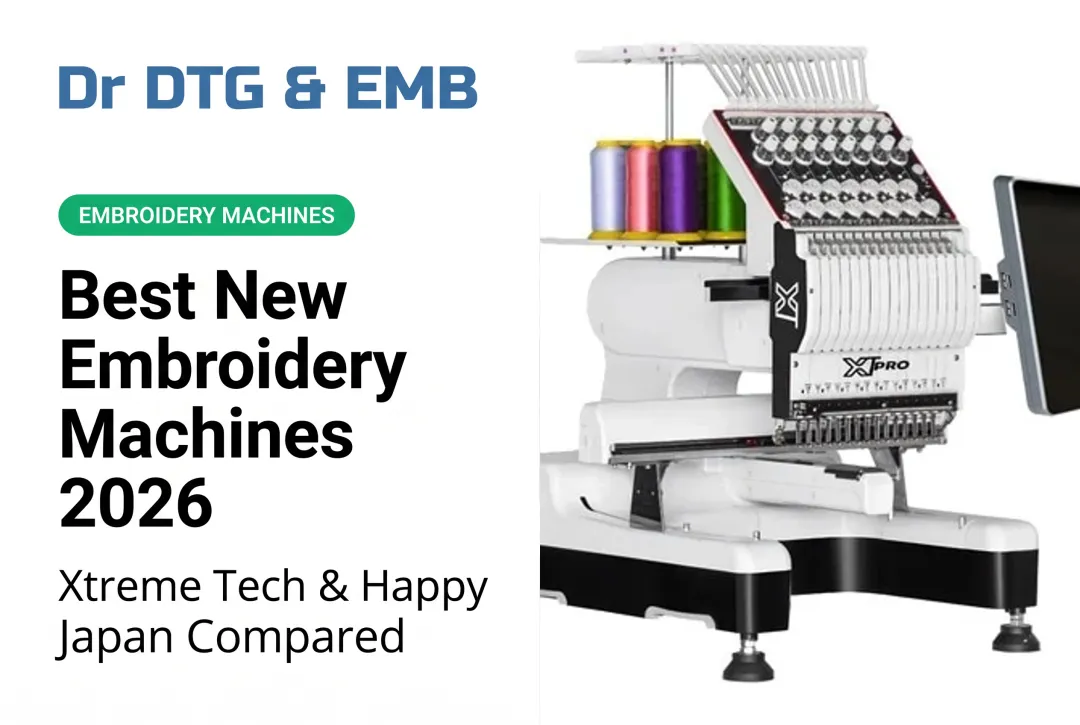
Dr. DTG has spent 23+ years placing Happy Japan Commercial Embroidery Machines - and offering parallel Xtreme Tech Pro Series options (XTPro 1401Ci, XTPro 1501 IPX, XTPro 1502IPX, XTPro XLS) - with demos, hands-on training, and long-term partnership support.
Key Takeaways
- Happy Japan entry commercial machines often publish dealer street pricing; Tajima US pricing is typically quote-based
- Cap kits and hoop sets are commonly included on Happy Japan commercial packages; Tajima cap frames are often sold separately
- Happy Japan suits startups and growing shops that need transparent total cost and faster operator ramp
- Tajima fits established high-volume industrial floors with experienced operators and larger capital budgets
- Dealer training, OEM parts, Isacord supplies, and certified repair determine real uptime more than brand prestige alone
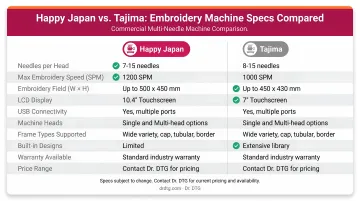
Happy Japan vs Tajima: Quick Comparison
| Spec | Happy Japan | Tajima |
|---|---|---|
| Entry price | Public dealer pricing common (7-needle commercial entry often near ~$9k class) | Quote-based |
| Needle count | 7 to 15 (single-head); multi-head options | 6, 9, 12, or 15 common |
| Max sewing speed | Up to ~1,500 SPM (HCU2 class) | Up to ~1,200 SPM on many single-head commercial models |
| Embroidery area | Large single-head fields on HCD3/HCU2 class | Strong industrial fields; model-dependent |
| Cap kit included | Often yes on commercial packages | Often sold separately |
| Interface | Color touchscreen commercial controls | Advanced industrial controls; model-dependent |
| Pricing transparency | Dealer-listed packages common | Must request quote |
Price and Package Value
Happy Japan offers visible street pricing through authorized dealers on many single-head models (e.g. Journey/HCH class and Voyager class). 15-needle HCD3E/HCU2 class units are commercial quote packages - still typically more transparent than pure industrial RFQ processes.
Tajima US distribution often routes buyers into demo/financing consultations without public MSRP. That model fits buyers who expect a full industrial sales process - not a cart checkout.
Needle Count, Speed, Field
- Happy Japan HCH / Journey class: 7 needles, strong compact commercial entry
- Happy Japan HCS3 Voyager class: 12 needles for mid flexibility
- Happy Japan HCD3E-X1501: 15 needles, large flat field, ~1,200 SPM class
- Happy Japan HCU2-1501: 15 needles, wider field, up to ~1,500 SPM flat
- Tajima TMBP2 / TMEZ class: 6-15 needles, up to ~1,200 SPM on many configs
Larger fields mean jacket backs, wide logos, and fewer "we can't take that job" moments - a direct revenue outcome for growing shops.
Included Accessories
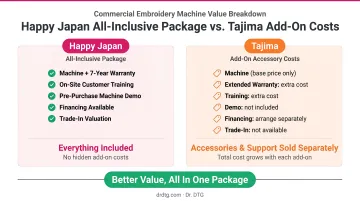
Happy Japan commercial packages frequently ship with multiple hoops and cap frame kits. Tajima lists many cap frames, pocket frames, and specialty units as optional - third-party cap frame sets alone can add roughly $900-$1,100. For a shop watching total cost of ownership, inclusion vs add-on changes the real number.
Warranty and After-Sales Support
Warranty headlines vary by dealer and region. What growing shops should demand in writing:
- Component-level coverage (drive train vs electronics vs consumables)
- OEM parts availability
- Certified repair path (field technician and/or depot)
- Hands-on training included with purchase
Dr. DTG packages Happy Japan Commercial Embroidery Machines with multi-year warranty options, training, and in-house technician support - because uptime is capacity.
What Is Happy Japan for Commercial Buyers?
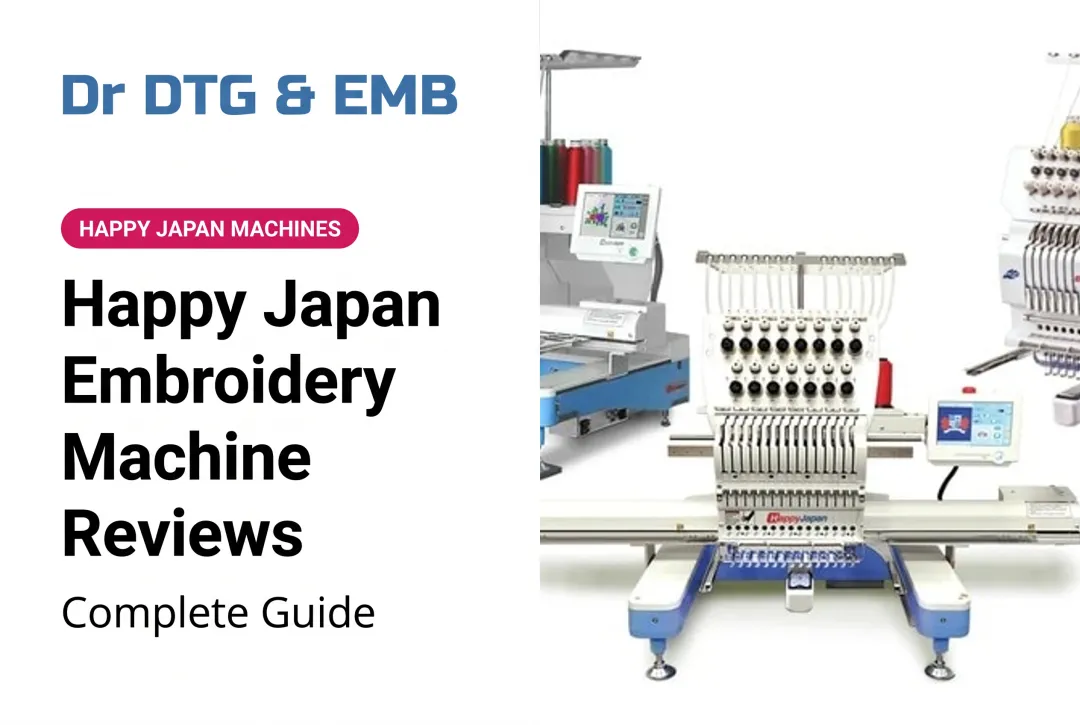
Happy Japan (Happy Japan Inc.) traces industrial roots to 1923 in Yamagata, Japan, with decades of multi-needle commercial embroidery manufacturing. Shops routinely report long production life when machines are maintained - a durability story that matters when financing spans years.
Model Range Growing Shops Use
| Model | Needles | Best For |
|---|---|---|
| HCH Plus | 7 | Compact commercial start, limited space |
| HCS3 Voyager | 12 | Mid-volume growth |
| HCD3E-X1501 | 15 | Multi-color commercial single-head standard |
| HCU2-1501 | 15 | High-output single-head |
| HCR3 (2-12 heads) | 15/head | Batch / multi-head scale |
Standard commercial features include color touchscreens, USB/LAN/Wi-Fi (HappyLink / HappyLAN), automatic trim, break detection, and error alerts. Higher tiers add digital tension control and automation that reduces operator intervention on demanding runs.
Use Cases
- Custom apparel multi-color logo work
- Cap and hat embroidery (cap kit often included)
- Promo merch and uniforms
- Home-based commercial shops scaling toward multi-head
- Sports, school, and corporate batch runs
Dr. DTG carries three Happy Japan models: the HCH Plus (7-needle), HCD3E-X1501 (15-needle), and HCR3-1504-45 (4-head) with financing, trade-in, on-site training, and certified repair - plus Isacord thread as USA Master Distributor.
What Is Tajima for Commercial Buyers?
Tajima (founded 1944, Aichi, Japan) developed early multi-head automatic embroidery technology and remains a dominant name on large industrial floors worldwide.
Core Strengths
- Deep industrial feature sets (intelligent thread management, digitally controlled presser feet on select lines)
- Broad multi-head ecosystem
- Strong brand recognition in high-volume facilities
- Specialty device options (sequin, cording, etc. on select configs)
Fit and Friction for Growing Shops
Tajima fits when daily stitch volume, experienced operators, and capital budget already match industrial norms. For shops still scaling, quote-only pricing, accessory add-ons, and higher total acquisition cost can delay the second head or the thread inventory that actually feeds production.
Which Is the Better Investment for a Growing Shop?
"Better" depends on where your order book is today - not a five-year aspiration slide.
Cost and Value
Happy Japan's transparent packaging and frequent inclusion of caps/hoops free operating capital for Isacord inventory, marketing, or a second head sooner. Tajima's industrial premium can be justified on established high-volume floors - harder to justify when you are still proving B2B volume.
Ease of Use and Training
Both brands offer modern connectivity. Happy Japan's operator-friendly commercial interfaces plus dealer hands-on training help new staff reach billable production faster - a real margin lever for growing shops.
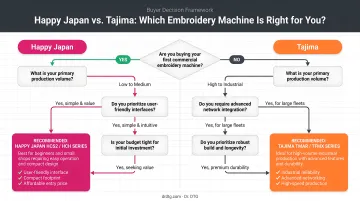
Decision Framework
Choose Happy Japan Commercial Embroidery Machines if:
- You are launching or scaling a custom apparel / embroidery business
- You want accessories and training packaged, not itemized surprises
- You value long warranty options and accessible certified repair
- You need a path from 7-needle to 15-needle single-head to multi-head
Choose Tajima if:
- You already run high-volume industrial output
- Experienced operators are on staff
- Industrial brand ecosystem and local technician density are your priority
- Capital budget is not the binding constraint
Also compare Xtreme Tech Pro Series through Dr. DTG - XTPro 1401Ci, XTPro 1501 IPX, XTPro 1502IPX, XTPro XLS - when IPX presser-foot control, multi-head step-up, or large-area production is the business outcome you need beside or instead of Happy Japan.
Conclusion
For most small-to-mid-size commercial embroidery and print shops, Happy Japan wins on total cost clarity, package value, operator ramp, and a model ladder that grows with volume. Tajima remains a strong industrial choice for established high-volume facilities.
Dr. DTG has partnered with production buyers for 23+ years: pre-purchase demos, hands-on training, certified repair, Isacord thread, needles, backings, bobbins, and DTG inks/pre-treatments for hybrid floors. Book a demo or consult a technician at 714-770-0969, info@drdtg.com, or visit 588 Explorer St., Brea, CA 92821.
Frequently Asked Questions
Is Happy Japan better than Tajima for growing shops?
Often yes on entry capital, included accessories, and training ramp. Tajima suits established industrial volume. Match brand to order book and support model.
How does price compare?
Happy Japan offers public dealer pricing on many entry/mid single-heads. Tajima is typically quote-based with more a la carte accessories that add to total cost. Compare all-in packages.
What about warranty?
Get component-level terms in writing from any dealer. Prioritize parts inventory and certified repair access over marketing year counts alone.
Which brand for small custom apparel?
Happy Japan Commercial Embroidery Machines - scalable from compact 7-needle to multi-head - are usually the stronger fit for small and growing custom apparel shops. Cap kits included reduce startup friction.
Do Happy Japan machines work with standard digitizing?
Yes - commercial shops commonly run .DST (and Happy .TAP where applicable). Confirm your digitizer output before purchase.
Can Happy Japan scale with my business?
Yes - from HCH Plus through HCD3E-X1501 to HCR3 multi-head. Dr. DTG trade-in and financing keep upgrades aligned with cash flow. Parallel Xtreme Tech Pro Series multi-head paths (XTPro 1502IPX and beyond) are available under the same partnership.