The problem is that most embroiderers default to whatever thread is on hand. What they don't realize is that weight governs needle size, stitch density, machine tension, and the final look of every project — all at once.
This guide covers how thread weight is defined and measured, the full spectrum from heavy to ultra-fine, how material type interacts with weight, and a practical framework for matching weight to fabric, design, and machine setup.
Key Takeaways
- Thread weight is counterintuitive: a higher number means thinner thread, not heavier
- 40wt is the industry default for most machine embroidery — knowing when to deviate separates good results from great ones
- Skipping needle size and stitch density adjustments when changing thread weight causes most thread breaks, puckering, and coverage failures
- Polyester, rayon, and cotton behave differently at the same weight — material and weight are independent variables
- Fine weights (60wt+) need higher stitch density; heavy weights (30wt) need density reduction or design scaling to compensate
What Thread Weight Means in Machine Embroidery
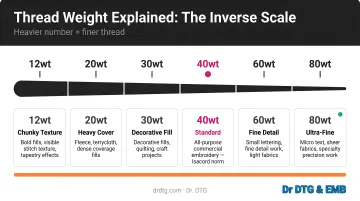
Thread weight is a length-to-mass ratio. According to Superior Threads, a thread labeled 40wt means that 40 kilometers of that thread weighs exactly 1 kilogram. A 30wt thread means 30 kilometers weighs 1 kilogram — so 30wt thread is physically thicker than 40wt.
That's the counterintuitive part most beginners miss.
The Inverse Relationship
In the weight (wt) system, higher number = finer thread, lower number = thicker thread. This is the opposite of denier (where a higher number means thicker) and Tex (same logic as denier). Confusing these systems — or just assuming "higher weight = heavier thread" — is one of the most common reasons beginners select the wrong thread for a project.
Reading a Thread Label
Most embroidery thread labels include two numbers, such as 40/2:
- The first number is the weight (thickness) — in this case, 40wt
- The second number is the ply — the number of strands twisted together
Ply affects strength and sheen but does not directly change the weight number. A 40/2 and a 40/3 thread are both "40wt," but the 3-ply version will feel slightly different in hand and behave differently under tension.
Weight as a Design Parameter
Thread weight isn't just a product label — it's an active variable in your embroidery system. Wilcom identifies 40wt as the standard embroidery thread weight, and most commercial digitizing software defaults its stitch density and spacing settings to this baseline.
Switch to a different weight without adjusting anything else and you'll see it immediately in your output: gaps in coverage, thread buildup, or snapped needles.
That's because thread weight controls several interdependent variables:
- Determines the needle eye size you need
- Sets the correct bobbin thread pairing
- Drives machine tension adjustments
- Defines the minimum stitch size for legibility
The Complete Spectrum of Embroidery Thread Weights
Machine embroidery thread weights span a wide range, but three practical categories cover the vast majority of use cases: heavy (12–30wt), standard (40wt), and fine (60wt and above). Each carries distinct performance implications.
Heavy Weights: 12wt to 30wt
30wt thread is visibly thicker than 40wt. The stitches sit higher, feel bolder, and work well for large fill areas, sports jersey numbers, and dimensional satin stitches. The trade-off is density management.
According to Superior Threads, when switching a design from 40wt to 30wt, you need to either reduce stitch density by one-third or scale the design up to 125% — otherwise thread buildup causes puckering or jams. Madeira's density guidelines put 30wt at an average density of 5.0 versus 4.0 for 40wt, confirming this directionally.
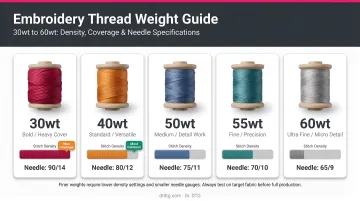
Needle guidance for 30wt varies by thread line and material. Madeira's Classic No.30 rayon lists a 75/11 needle, while Superior recommends larger needles (up to 100/16) for heavy threads — so always check your thread manufacturer's spec sheet rather than relying on a universal chart.
12wt to 18wt threads are specialty weights for decorative topstitching, bold quilting lines, or intentional textural effects. Madeira's Burmilana No.12 runs on a 100/16 needle and requires slightly reduced machine speed and adjusted tension. No commercial digitized embroidery design is intended for these weights without significant reworking — which is worth keeping in mind before committing to a specialty spool.
Standard Weight: 40wt
40wt is the universal baseline. Virtually all commercial embroidery is digitized around this weight, making it compatible with the widest range of designs, fabrics, and machines without requiring density adjustments.
Isacord is one of the most widely trusted 40wt polyester options in commercial embroidery — rated for high-speed multi-needle machines and known for consistent tension and colorfastness across long production runs. Dr. DTG carries the full 390-color Isacord catalog in 1000m and 5000m spools as the USA Master Distributor.
For reference, Madeira's Polyneon No.40 (also a 40wt polyester) lists a denier of 120 x 2 and runs on needles from 60/8 to 75/11 depending on the application.
Fine Weights: 60wt and Above
60wt thread is the go-to for fine detail work: small lettering down to approximately 3mm, micro logos, intricate monograms, and anything that looks crowded or blurry in 40wt. Madeira lists 60wt at an average density of 3.5 (versus 4.0 for 40wt), and Impressions Magazine notes that 60wt thread is 25–30% thinner than 40wt, requiring corresponding density increases to maintain coverage.
Key specs for fine weights at a glance:
- 60wt: Needle range 60/8 to 65/9 (Madeira Classic and Polyneon No.60); average density 3.5
- 75wt: Runs on a 60/8 needle; best for finest lettering and filigree detail work
- 80wt and above: Primarily used as bobbin/underthread in appliqué and stitch-in-the-ditch applications, not as top thread
Thread Material Types and Their Weight Behavior
Thread weight and thread material are two independent variables that interact. The same "40wt" label behaves differently depending on whether it's polyester, rayon, or cotton, affecting sheen, durability, and how your machine handles it at production speeds.
Polyester vs. Rayon vs. Cotton at 40wt
| Material | Sheen | Durability | Best For |
|---|---|---|---|
| Polyester | Medium | Excellent | Commercial production, high-wash garments |
| Rayon/Viscose | High (lustrous) | Moderate | Decorative, detail work, lower-wash items |
| Cotton | Matte/natural | Good | Vintage aesthetics, specialty applications |
Here's what each material actually delivers at 40wt:
- Polyester: Best wash resistance of the three. Madeira's Polyneon Green No.40 withstands washing at 95°C under DIN EN ISO 105-C04 standards, rating 4–5 on a 1–5 scale. For commercial garments that get laundered frequently, polyester is the clear choice.
- Rayon/viscose: Produces a softer, more vibrant finish. Madeira's Classic rayon averaged 400,000 stitches without a thread break and runs at 1,200 stitches per minute — competitive with polyester on speed, but more sensitive to bleach and harsh wash conditions.
- Cotton: Delivers a matte, natural look suited to vintage or hand-embroidery aesthetics. High-speed performance data for 40wt cotton is less established than for polyester or rayon, so test before committing to production runs.
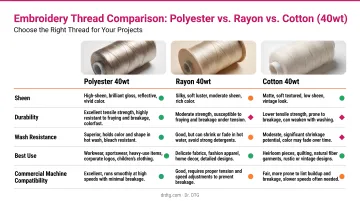
One thing the table above can imply — but shouldn't — is that rayon tops out at 40wt. That's not accurate. Madeira sells Classic Rayon No.60 specifically for high-speed multi-head machines, so fine-weight rayon is a real option, not just a polyester specialty.
Matching Thread Weight to Your Project
Thread weight selection is a three-way decision involving fabric type, design complexity, and machine setup. No single weight is universally correct.
Fabric Type and Thread Weight Pairing
The pairing logic follows the fabric's structure and weight:
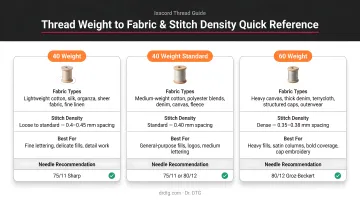
- Lightweight or delicate fabrics (fine knits, performance wear, children's clothing) — use 60wt or finer to prevent puckering, distortion, and needle trauma
- Medium-weight fabrics (cotton twill, poplin, standard fleece) — 40wt is the reliable default
- Heavy fabrics (denim, canvas, thick felt) — 30wt provides bold coverage without the thread sinking into the material
Needle Size Coordination
Needle-to-thread matching is non-negotiable. A needle eye that's too small shreds the thread; one that's too large for the fabric leaves visible holes.
| Thread Weight | Needle Size (General Range) |
|---|---|
| 30wt | 90/14 to 100/16 (varies by thread line) |
| 40wt | 75/11 (Wilcom standard; some lines use 65/9–75/11) |
| 60wt | 60/8 to 65/9 |
| 75wt+ | 60/8 |
Dr. DTG stocks Groz-Beckert 80/12 KK needles for 3D puffy foam work. For all other thread weights — especially anything outside the 40wt standard — consult the thread manufacturer's spec sheet for exact needle recommendations before running production.
Design Density Adjustments
Most commercial designs are digitized assuming 40wt thread. When you change weight, density must follow:
- 40wt → 60wt: A logo at density 4.0 will show visible gaps. Since 60wt runs 25–30% thinner, increase stitch density to match the design's visual coverage requirement — without this, colors look washed out and fabric shows through.
- 40wt → 30wt: That same logo will pucker and jam. Reduce density by one-third or scale the design up to 125%. Heavier thread cannot physically fit into stitch spacing calibrated for finer thread.
Quick-Reference Weight Summary
Use this table as a starting point — then fine-tune based on your specific fabric and design:
| Weight | Best Applications |
|---|---|
| 30wt | Large fill areas, bold effects, sports lettering, heavy fabrics |
| 40wt | General purpose, logos, standard garments, most digitized designs |
| 60wt | Fine lettering (3mm+), intricate detail, monograms, lightweight fabrics |
| 75wt+ | Fine bobbins, appliqué, near-invisible stitching, filigree |
Dr. DTG's Happy Japan and Xtreme Tech XTPro machines support a full range of thread weights — but tension settings and needle selection vary by weight class. Call Dr. DTG at 714-770-0969 for machine-specific setup guidance when running anything outside the 40wt standard.
What Happens When You Use the Wrong Thread Weight
The mismatch between thread weight, design density, and needle size creates a cascading failure. Each scenario produces a distinct set of problems:
- Too-heavy thread in a high-density design: Thread buildup between stitches causes puckering, jams, or needle breakage. The machine forces more material into each stitch than the design's spacing was built to handle.
- Too-fine thread in a low-density design: Insufficient coverage leaves visible gaps between stitches and washed-out colors. The thread simply doesn't fill the space it was meant to.
- Mismatched needle-to-thread size: Superior Threads notes that the needle eye should be approximately 40% larger than the thread diameter. Too small, and the thread shreds at the eye — causing inconsistent stitch formation and frequent breaks.
Common Misconceptions
"Higher weight number = heavier thread." This is backwards. A 60wt thread is finer than a 40wt thread. Confusing this leads beginners to select heavy thread when they need fine detail, or vice versa.
"I can switch thread weights without changing anything else." You cannot. Changing thread weight without adjusting needle size, machine tension, and stitch density is one of the most common sources of embroidery quality problems. Thread weight is not a like-for-like swap — it requires reconfiguring every connected variable.
Conclusion
Thread weight governs needle selection, stitch density, machine tension, and how thread interacts with your fabric — all at once. Treating it as a passive choice produces inconsistent results.
The practical approach: start with 40wt as your default. Learn to recognize when your design or fabric demands a deviation — fine lettering below 5mm, delicate knit fabrics, or large-format fill areas on heavy material. When you deviate, adjust needle size and stitch density in tandem. And always test on scrap material before committing to a full production run.
Once you internalize those adjustments, thread weight stops being a source of rework and starts being a tool you reach for deliberately.
Frequently Asked Questions
What weight thread should I use for machine embroidery?
40wt is the standard starting point and works with nearly all digitized designs right out of the box. Use 60wt for fine detail or small lettering, and 30wt for bold, large-area designs on heavy fabric where you want more visual weight per stitch.
Is 60wt thread thinner than 40wt?
Yes. In the thread weight system, higher numbers mean finer thread. 60wt is noticeably thinner than 40wt, producing crisper detail in small elements, but it requires increased stitch density to maintain adequate coverage.
What do you use 40wt thread for?
40wt is the embroidery industry's universal standard, suitable for logos, general garment embroidery, most commercial designs, and a wide range of fabrics. It's the weight assumed by most digitizing software and requires no density adjustments out of the box.
Should you go lighter or darker with thread?
No universal rule applies, but the common professional guideline is to match thread color closely to the fabric for fill areas. When an exact match isn't available, slightly darker thread tends to work better, since thread typically reads lighter once stitched out. Reserve contrast for outline or detail elements only.
What needle size should I use with different thread weights?
Key pairings: 30wt → 90/14 to 100/16 (varies by thread line); 40wt → 75/11 (standard); 60wt → 60/8 to 65/9. Mismatching needle to thread weight is a leading cause of shredding and inconsistent stitch formation.
Do I need to adjust my embroidery design when changing thread weight?
Yes. Switching to 60wt requires increased stitch density, since the thinner thread needs more stitches for coverage. Switching to 30wt requires density reduced by roughly one-third, or the design scaled to 125%. It's not a direct swap.