Introduction
Embroidery thread is not a universal supply — grab the wrong one and you're looking at broken threads mid-run, colors that bleed in the first wash, and uneven stitching that kills an otherwise well-digitized design. For a commercial embroidery operation, any of those means a production stop.
Machine embroidery thread is engineered differently from regular sewing thread. As BERNINA explains, it is less twisted and spreads more evenly across stitches, with a smoother surface that handles the heat and friction of high-speed stitching without shredding or breaking.
This guide breaks down the main thread types for machine embroidery, the brands commercial shops consistently reach for — including Isacord, which Dr. DTG distributes across the USA — and how to match your thread choice to the project in front of you.
Key Takeaways
- Polyester is the standard choice for commercial work — colorfast, wash-resistant, and holds color through 50+ commercial wash cycles
- 40wt is the industry-standard weight; use 60wt for small lettering and fine detail
- Top brands: Isacord, Madeira, Robison-Anton, Floriani, and Sulky — Isacord leads for commercial shops; others suit niche or hobbyist use
- Wrong thread = breakage, lint buildup, color bleeding, and machine downtime
- Match thread to your fabric, wash requirements, and stitch density — the wrong combination costs time and materials
Types of Embroidery Thread for Machine Use
The fiber composition of a thread determines how it behaves at speed, how it looks on fabric, and how it holds up through laundering. Here's how the main thread types compare — and where each one performs best.
Polyester Thread
Polyester is the most widely used thread for machine embroidery — and for good reason. It handles repeated washing without fading or bleeding, resists UV exposure, and tolerates the tighter machine tensions that commercial production demands.
Madeira's Polyneon line confirms that 100% polyester thread is engineered to reduce looping, puckering, and thread breaks, while also being resistant to chlorine bleach — making it a direct fit for uniforms, workwear, sportswear, and commercial linen applications.
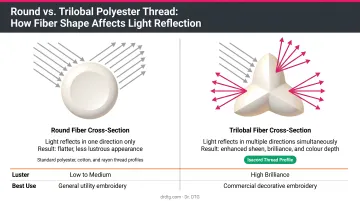
Why trilobal polyester matters: Standard polyester has a round cross-section. Trilobal polyester has a triangular shape whose flat sides reflect light at multiple angles, producing a glossy finish that rivals rayon. This is the construction used in premium commercial threads like Isacord. This is the construction used in premium commercial threads like Isacord — available in 390 colors through Dr. DTG, the USA Master Distributor.
Best for: uniforms, caps, bags, sportswear, high-volume commercial production.
Rayon (Viscose) Thread
Rayon produces a silk-like sheen that polyester — even trilobal — doesn't fully replicate. Madeira's Classic Rayon is a good example: 100% viscose rayon with high tensile strength and glossy luster, available in #30, #40, and #60 weights for different applications.
The tradeoff is durability. Rayon doesn't handle industrial washing as well as polyester, and it tolerates tighter machine tensions less reliably. For decorative embroidery, fashion garments, and home décor where visual finish takes priority over heavy use, rayon delivers a superior result.
Best for: decorative pieces, fashion embroidery, gifts, home décor.
Cotton Thread
Cotton offers a matte, natural finish well-suited to vintage, heirloom, and rustic embroidery styles. It runs cleanly on commercial machines — Gunold's Cotty 30wt is one example designed specifically for high-speed commercial use.
One practical note: BERNINA recommends cleaning the hook area more frequently when using cotton thread, as it produces more lint than polyester at high speed.
Best for: vintage aesthetics, quilting-style embroidery, natural-fabric projects.
Metallic Thread
Metallic thread adds high-shine or glittery accents to logos, festive apparel, and decorative stitching. It requires adjustments most embroiderers learn the hard way:
- Slow the machine down — Madeira recommends 600–650 stitches per minute for Supertwist #30 metallic
- Use a larger-eye needle — a #90/14 needle gives the thread more room to pass through at speed
- Adjust top tension — Madeira suggests starting at 170gf for metallic, then adjusting from there
Best for: logos, decorative accents, festive wear, branded apparel with shimmer detail.
Specialty Threads
A few niche categories worth knowing:
- Wool blends (like Madeira Burmilana #12, 50% wool / 50% acrylic) produce a hand-embroidered look with reduced stitch density and require a #100/16 needle
- Ultra-fine threads (80wt–100wt) such as WonderFil InvisaFil are used for lace embroidery, fine monogramming, and near-invisible applications
- Glow-in-the-dark threads (Sulky Glowy, Madeira Luna) serve niche applications in children's wear and safety apparel
Top 5 Embroidery Thread Brands for Machine Embroidery
Brand quality directly affects stitch consistency, color accuracy, and how your finished goods hold up. The brands below span the full range — from high-volume commercial production to home decorative work — and are the ones professional embroiderers and commercial shops return to consistently.
Isacord
Isacord is manufactured by AMANN in Germany and is the go-to thread for commercial multi-needle machines. Its construction — continuous-filament, trilobal polyester — delivers exceptional colorfastness, high abrasion resistance, and consistent diameter across production runs.
For businesses running repeat orders on uniforms or branded apparel, color consistency across dye lots is non-negotiable. Isacord is engineered specifically for that requirement.
Dr. DTG holds Master Distributor status for Isacord in the USA, carrying the full 390-color catalog in both 1000m and 5000m spools — priced from $5.29 per 1000m spool, with wholesale pricing and pre-curated 50-spool kits available for commercial shops.
| Spec | Detail |
|---|---|
| Material | 100% Trilobal Polyester |
| Weight | 40wt (Tex 27) |
| Colors | 390 |
| Best For | Uniforms, sportswear, corporate apparel, commercial production |
Madeira
Madeira is one of the world's largest embroidery thread manufacturers, with a product range covering both rayon and polyester lines. Their Classic Rayon and Polyneon lines are well-established across home and industrial machines alike.
What sets Madeira apart is weight range. Polyneon runs in #40 for general use, #60 for fine detail, and #75 for very fine detailing — giving embroiderers precise control over thread coverage without switching brands.
| Spec | Detail |
|---|---|
| Material | Rayon and Polyester (multiple lines) |
| Weight | 30wt, 40wt, 60wt, 75wt options |
| Best For | Commercial embroidery, fashion work, home décor |
Robison-Anton
Now owned by American & Efird (A&E), Robison-Anton has one of the broadest color libraries available in commercial embroidery thread. The Super Brite Polyester line offers 453 colors in 40wt; Super Strength Rayon offers 370 colors in 40wt. An ECO100 recycled trilobal polyester variant adds more than 450 Pantone-matched shades.
For embroidery businesses that need exact brand color matching across large orders, that depth of color library is a genuine differentiator.
| Spec | Detail |
|---|---|
| Material | Rayon and Polyester |
| Weight | 40wt primary (35wt rayon also available) |
| Colors | 370–453 depending on product line |
| Best For | Logo work, precise color matching, commercial orders |
Floriani
Floriani's 40wt polyester thread is formulated for multi-needle machine production — lubricated for consistent tension, high-tensile-strength, and rated for colorfast performance with a five-year dye-lot guarantee across its 360+ color range.
The brand also offers a 12wt polyester for bold decorative embroidery, quilting, and heavy fabrics like denim and canvas. Floriani's broader product ecosystem (stabilizers, digitizing tools) appeals to production shops that want a unified system rather than sourcing each component separately.
| Spec | Detail |
|---|---|
| Material | 100% Polyester |
| Weight | 40wt standard; 12wt available |
| Colors | 360+ |
| Best For | Multi-needle commercial machines, high-volume production |
Sulky
Sulky covers more thread categories under one brand than most: rayon, cotton, metallic, and ultra-fine polyester. That breadth makes it particularly practical for home embroiderers and decorative projects where variety matters more than commercial volume.
Notable product lines:
- 40wt Rayon — silk-like luster for decorative embroidery
- 30wt Cotton Blendables — matte finish for quilting-style and vintage work
- Original Metallic — round twisted metallic thread bonded around a strong core
- 60wt PolyLite — fine-weight polyester that works as a companion bobbin thread for metallics and rayon
| Spec | Detail |
|---|---|
| Material | Rayon, Cotton, Metallic, Fine Polyester |
| Weight | 12wt, 30wt, 40wt, 60wt |
| Best For | Home embroidery, decorative projects, mixed-media |
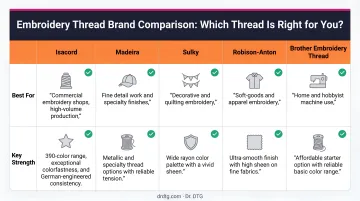
Which Brand Fits Your Work?
| Brand | Best User | Key Strength |
|---|---|---|
| Isacord | Commercial shops | Colorfastness, dye-lot consistency |
| Madeira | Commercial + home | Widest weight range |
| Robison-Anton | Logo / color-match work | Largest color library |
| Floriani | Multi-needle production | Unified system (thread + supplies) |
| Sulky | Home / decorative | Broadest thread type variety |
How to Choose the Right Embroidery Thread for Your Project
Thread selection comes down to four practical decisions.
Match Weight to Detail Level
BERNINA notes that most designs are digitized for 40wt thread — it's the default for good reason. Use 60wt when you need finer detail, particularly for lettering around 5mm or smaller. Weights like 80wt–100wt are reserved for lace embroidery and near-invisible applications.
Match Material to Use Case
| Project Type | Recommended Thread |
|---|---|
| Workwear, uniforms, athletic wear | 40wt polyester (Isacord, Floriani, Madeira Polyneon) |
| Decorative, fashion, gifts | 40wt rayon (Madeira Classic Rayon, Sulky Rayon) |
| Vintage, quilting, natural fabrics | 30wt cotton (Sulky, Gunold Cotty) |
| Logos with shimmer accents | Metallic (Madeira Supertwist, Sulky Original Metallic) |
For polyester specifically, Dr. DTG carries the full Isacord catalog — 390 colors in 1000m and 5000m spools — as the USA Master Distributor of the brand.
Run a Test Before Full Production
Before committing to a full run — especially with dark colors on light fabrics — test your thread on a fabric swatch. Wash it and check for bleeding or color shift. Sulky recommends machine washing dark thread colors before beginning production to confirm colorfastness.
Use the Right Bobbin Thread
Most commercial setups use a lighter bobbin thread (60wt–90wt) rather than matching the top thread. BERNINA explains that lighter bobbin thread allows the upper thread to pull cleanly to the back of the embroidery, improving tension balance and reducing bulk. Brother's 90wt white polyester bobbin thread is one common example.
Watch for Warning Signs
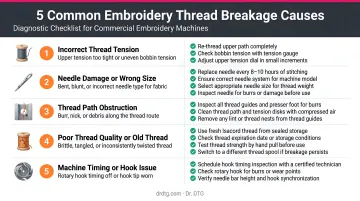
Frequent breakage, lint accumulation, uneven stitches, or color bleeding after washing all point to a mismatch in thread material, weight, or brand quality. The most common causes:
- Tension set too tight for the thread type
- Wrong needle size (especially with metallic)
- Old or degraded thread on the spool
- Thread weight not suited to design density
- Running metallic thread at standard embroidery speed
Conclusion
Thread selection isn't secondary to machine setup — it's part of the same decision. Choosing thread based on material, weight, brand, and project requirements separates consistent, professional-grade output from rework and downtime.
For businesses building a commercial embroidery operation, starting with commercially tested, premium thread eliminates one of the most common sources of production problems.
If you're sourcing Isacord thread, Dr. DTG — USA Master Distributor of Isacord Thread since 2003, BBB A+ accredited — carries the full 390-color catalog in 1000m and 5000m spools, with volume pricing for commercial shops. Call 714-770-0969 or browse the complete thread catalog at drdtg.com.
Frequently Asked Questions
What is the best embroidery thread for machine embroidery?
Polyester thread (specifically trilobal polyester like Isacord) is the top choice for most professional machine embroiderers. It offers superior durability, consistent colorfastness, high-speed machine compatibility, and reliable tension performance. Rayon is preferred when a higher natural sheen is the visual priority.
Is machine embroidery thread different from regular sewing thread?
Yes. Machine embroidery thread is less twisted and smoother than standard sewing thread, which allows it to spread evenly across stitches and run at embroidery machine speeds without generating excessive friction, lint, or breakage.
What is the best thread weight for machine embroidery?
40wt is the standard for the vast majority of machine embroidery — most designs are digitized for it. Use 60wt for fine detail work and small lettering; 80wt–100wt is reserved for lace embroidery and near-invisible applications.
Can I use regular sewing thread in an embroidery machine?
Technically yes, but results are poor. Regular sewing thread is more tightly twisted, which creates rougher texture, higher lint buildup, and more frequent breakage at embroidery machine speeds. Use purpose-built embroidery thread — it's the right tool for the job.
What causes embroidery thread to keep breaking?
The most common causes are incorrect tension, wrong needle size, degraded thread, running metallic thread at standard speed, or a mismatch between thread weight and design density. Checking the threading path and needle condition first resolves most breakage issues.
What is the difference between polyester and rayon embroidery thread?
Polyester handles frequent washing without fading, making it the go-to for workwear and commercial applications. Rayon trades some durability for a softer, higher-sheen finish. Choose based on whether longevity or visual appearance matters more for your project.