Introduction
You've spent hours getting a design digitized perfectly. The machine runs clean. Then the finished piece comes off the hoop — and it's puckered, the letters are pulling, or after the first wash, the design starts losing its shape. Nine times out of ten, the backing was wrong.
Embroidery backing (also called stabilizer) is one of the most important decisions in embroidery — yet it's consistently the most overlooked. Many embroiderers grab whatever's on hand, or default to the same material for every project. The result: wasted garments and unhappy customers.
This guide covers the five main types of embroidery backing, how to match each to your fabric and design, and the three most common mistakes that cost embroiderers real money. Whether you're running a single-needle setup or scaling up with multi-head commercial equipment, the right backing decision will show in every finished piece.
Key Takeaways
- Embroidery backing prevents fabric from distorting, puckering, or stretching during and after stitching
- Five main types exist: cutaway, tear-away, water-soluble backing, water-soluble topper, and no-show mesh
- Stretchy or unstable fabric = cutaway; structured, stable fabric = tear-away starting point
- Every backing decision comes down to two factors: fabric construction and design density
- Wrong backing is a top cause of failed projects — even with flawless digitizing
What Is Embroidery Backing and Why Does It Matter?
Embroidery backing — also called stabilizer — is a material placed beneath the fabric during hooping to give it structure and support while the machine stitches. The terms are interchangeable; manufacturers and shops use both.
Most fabrics cannot handle machine embroidery on their own. Every needle strike creates tension. As Madeira describes it, backing keeps fabric smooth and stable during embroidery, preventing puckering, shifting, distortion, and poorly formed stitches. With dense, high-stitch-count designs, that tension multiplies — the fabric gets pulled from multiple directions thousands of times over the course of a single run.
Choosing the right backing comes down to two variables:
- Fabric construction — woven or knit, stable or stretchy, thick or thin
- Design density and stitch count — how many stitches, how much fill coverage, how concentrated the stitching is
Nail both, and the finished piece looks clean and holds up through repeated washing. Miss either one, and even a perfectly digitized design can fail.
The Main Types of Embroidery Backing Materials
The right backing comes from matching material properties to your specific fabric and design — not personal preference or habit.
Cutaway Stabilizer
Cutaway is a non-woven material that gets trimmed around the design after embroidery and stays permanently attached to the garment. It's the most durable backing option available.
As Melco notes, cutaway is the correct choice for knits, performance wear, polos, t-shirts, and lightweight jackets — any fabric with significant stretch — because it provides lasting support through repeated washing. BERNINA puts it simply: the more elastic the fabric, the more stable the stabilizer must be.
Cutaway comes in multiple weights, and matching weight to design directly affects stitch quality and garment longevity:
| Factor | Light (~1.5 oz) | Medium (~2.0–2.5 oz) | Heavy (~3.0+ oz) |
|---|---|---|---|
| Best Fabric Types | Sheer knits, lightweight stretch | Standard knits, polos, t-shirts | Heavy stretch, jersey, unstable knits |
| Design Density | Low stitch count, open designs | Standard fills, moderate density | Dense fills, high stitch count |
| Removal Method | Trim close to design edges | Trim close to design edges | Trim close to design edges |
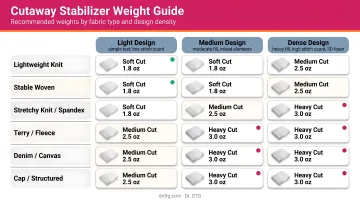
Because the backing stays with the garment permanently, the design holds its shape and stitch alignment through years of wear and washing — something no tearaway can replicate.
Tear-Away Stabilizer
Tear-away is a crisper, paper-like non-woven material removed by tearing after embroidery — designed for structured, stable fabrics that hold stitches on their own without permanent support.
| Factor | Light (1.0–1.5 oz) | Medium–Heavy (2.0–3.0 oz) |
|---|---|---|
| Best Fabric Types | Denim, canvas, twill, heavier woven jackets | Caps, towels, structured woven fabrics |
| Design Density | Small solid designs, outlines | Larger or denser designs |
| Removal Method | Tear away cleanly after stitching | Tear away; may require scoring around design |
No cutting required — tear-away removes fast, which adds up in high-volume production environments.
Critical warning: Never use tear-away on stretchy or knit fabrics. AllStitch confirms it may not hold up during embroidery and can distort if pulled too hard. More importantly, it provides no lasting support — designs on knits will warp over time without permanent backing.
Water-Soluble Stabilizer (Backing)
Water-soluble backing is a dissolvable material placed behind the fabric for projects where zero backing residue is acceptable — or required.
| Factor | Details |
|---|---|
| Best Fabric Types | Lace, batiste, chiffon, organza, Lycra, Spandex, cutwork, heirloom embroidery |
| Design Density | Light to moderate; freestanding lace; cutwork designs |
| Removal Method | Submerge or rinse with warm water — dissolves completely |
Critical tip: BERNINA recommends adding a basting stitch around the design perimeter when using water-soluble backing. Its adhesive hold is less aggressive than other backing types, and it can shift during stitching if not secured.
Water-Soluble Topper
The topper is applied on top of the fabric — not underneath. Its purpose is different from backing entirely.
On high-loft, textured surfaces like terrycloth, fleece, velvet, or corduroy, stitches sink into the fabric pile during embroidery. The result is a design that looks undefined and buried rather than crisp. A water-soluble topper holds the fibers flat while the needle punches through, keeping stitch edges clean and visible.
| Factor | Details |
|---|---|
| Best Fabric Types | Terry cloth, fleece, velour, faux fur, suede, felt, corduroy |
| What It Prevents | Stitches sinking into pile; towel loops showing through; undefined stitch edges |
The topper works alongside a backing — it does not replace it. After embroidery, excess tears away and any remnants dissolve with water.
No-Show Mesh / Lightweight Woven Backing
No-show mesh (also called performance backing or polymesh) is a semi-permanent cutaway backing designed for lightweight or light-colored fabrics. Standard cutaway on these fabrics creates a visible outline — the "halo effect" — or adds bulk that shows through the finished garment.
| Factor | Details |
|---|---|
| Best Fabric Types | Athletic wear, polo shirts, lightweight knits, performance fabrics |
| Key Benefit | Eliminates the "halo effect" — visible backing outline showing through thin or light-colored fabrics |
| Weight Options | Typically ~1.5 oz (thin, translucent, soft) |
Products like AllStitch SheerStitch are described as lightweight, 100% nylon, and translucent — specifically engineered to disappear behind the fabric rather than create a visible shadow. For professional finished apparel, this is the preferred backing for light-colored polo shirts and performance wear.
How to Choose the Right Embroidery Backing
Step 1: Assess Fabric Construction
Pull the fabric gently. Does it stretch?
- Stretches → Start with cutaway (light, medium, or heavy depending on weight and density)
- Holds its shape → Tear-away is your starting point; confirm with design density
Fabric categories and their defaults:
| Fabric Type | Default Backing |
|---|---|
| Knits, t-shirts, athletic wear | Cutaway (medium weight) |
| Denim, canvas, twill | Tear-away |
| Lightweight, light-colored performance apparel | No-show mesh cutaway |
| Terry cloth, fleece, velour | Tear-away or cutaway + water-soluble topper |
| Sheer, delicate, or lace | Water-soluble backing |
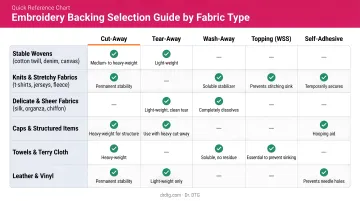
Step 2: Evaluate Design Density
High stitch-count, fully filled designs need heavier backing support. Open designs with outlines and minimal fill can use lighter options.
General density guidance (qualitative, as no universal stitch-count standard exists across manufacturers):
- Open/outline designs → Light backing
- Standard fill coverage → Medium backing
- Dense fills, heavily layered stitch areas → Heavy backing; consider additional backing layer
Step 3: Back and Fabric Go In the Hoop Together
This is a step many embroiderers get wrong. The backing and fabric must always be hooped together with even tension — not the backing alone, then the fabric laid on top.
Uneven tension between backing and fabric is one of the most consistent causes of design distortion, regardless of which stabilizer you've chosen.
This principle holds at every scale — but the stakes are higher in commercial settings. If you're running multi-head machines like the Happy Japan or Xtreme Tech XTPro series, standardizing backing choices by garment type directly reduces error rates and reorder waste. Dr. DTG carries 44 backing products plus 15 specialty backing options, and the team can help you build a standardized selection for your operation.
Common Backing Mistakes to Avoid
Mistake 1: Using Tear-Away on Stretchy Fabrics
This is the most frequent costly error for new embroidery business owners. Tear-away provides no permanent support — on knits and t-shirts, the design loses structure and warps after repeated washing. If the fabric stretches, the backing must stay. Use cutaway, always.
Mistake 2: Using the Wrong Weight for the Design
Defaulting to a single backing weight for every project is a reliable way to produce inconsistent results:
- Light backing on a dense design → puckering, misregistration, design distortion
- Heavy backing on a simple outline design → unnecessary stiffness and bulk in the finished garment
Match weight to density. A left-chest logo on a polo and a fully filled back design on a jacket do not use the same backing weight.
Mistake 3: Skipping the Topper on Textured Fabrics
Stitching directly onto terry cloth or fleece without a water-soluble topper causes stitches to sink into the pile. The result is unprofessional — undefined edges, inconsistent coverage, and fabric loops visible between stitch lines. A water-soluble topper holds those loops flat and keeps stitches on the surface where they belong.
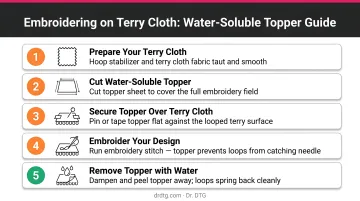
Signs you needed a topper and skipped it:
- Stitch lines look sunken or uneven across the design
- Fabric pile shows through between fill stitches
- Edges appear ragged or undefined after the top layer is removed
Conclusion
Backing selection is not a secondary step. It's as fundamental to the final result as the digitizing, the thread quality, and the machine settings. Choosing backing by fabric type and design density — not habit or whatever's nearby — is what separates consistent professional output from inconsistent results that cost time and money.
Getting backing right is only part of the equation. The machine running those designs needs to be equally reliable. Dr. DTG — operating since 2003, stocking backing, Isacord thread, and needles, and selling commercial embroidery machines from Xtreme Tech XTPro and Happy Japan — is a single source for supplies and equipment as you build or expand your shop. Schedule a machine demo or browse their inventory at drdtg.com.
Frequently Asked Questions
Where can I buy backing for embroidery?
Online specialty suppliers offer far better variety and pricing than local craft stores. For business use, buying in bulk rolls instead of pre-cut sheets cuts cost per unit significantly. Dr. DTG carries backing for commercial embroidery applications and can help match the right type to your setup.
What is the difference between cutaway and tear-away stabilizer?
Cutaway stays permanently attached to the garment after trimming and is essential for stretchy or unstable fabrics. Tear-away is removed completely after stitching and is suited for structured, stable fabrics like denim and canvas. Permanence is the key difference, and it matters most when working with knits.
Do you need stabilizer for all embroidery projects?
For machine embroidery, yes — almost always. The type and weight will vary by project, but even stable woven fabrics benefit from at least a light tear-away to prevent puckering and maintain registration during stitching.
What backing should I use for embroidery on stretchy fabric?
Use cutaway stabilizer for all knit and stretchy fabrics. It provides permanent support that holds the design in shape through repeated washing and wear — tear-away will not hold up on stretch materials.
How do I know what weight stabilizer to use?
Tie weight directly to design density: light backing for outline or low-stitch-count designs, medium for standard fills, and heavy for dense fully-filled designs or very unstable fabrics. If the choice is close, go one weight heavier — trimming excess backing is easier than fixing a puckered design after the fact.
Can I use a water-soluble topper as the only stabilizer?
No. A topper manages surface texture on top of the fabric — it provides no structural support beneath it. It always works in combination with a backing, not as a substitute. Using topper alone leaves the fabric completely unsupported during stitching.