Introduction
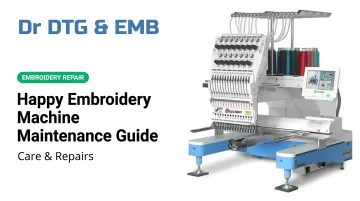
Happy Japan machines are precision commercial equipment — built for high-volume production, tight stitch tolerances, and years of reliable output. That reliability depends on consistent, structured maintenance.
Skip the basics and the consequences stack up fast: repeated thread breaks mid-job, rotary hook wear that degrades stitch quality, error codes that halt production, and repair bills that far exceed what routine upkeep would have cost.
As Impressions Magazine notes, technicians are expensive and their schedules are tight — waiting until something breaks is never the cheaper option.
This guide covers what you need to keep a Happy Japan machine running at full capacity:
- Maintenance categories and what each involves
- Early warning signs to catch problems before they escalate
- Hands-on preventive care tasks
- A practical maintenance schedule
- When to call a professional technician
Key Takeaways
- Happy machines need regular oiling, lint cleaning, tension checks, and needle inspection to run without interruption
- The rotary hook, needle bars, and thread path are the highest-priority maintenance points
- Thread breaks, unusual sounds, and error codes like E-050 each point to specific mechanical causes — not random bad luck
- A daily/8-hour, 40-hour, and periodic deep-service schedule prevents most breakdowns before they start
- Skipping preventive maintenance trades a few minutes of upkeep for hours of downtime and hundreds in repair costs
Types of Happy Embroidery Machine Maintenance
Maintenance falls into three distinct categories. Knowing which applies to your situation determines how you respond, and what it will cost.
Routine / Preventive Maintenance
Preventive maintenance is regularly scheduled upkeep performed regardless of whether the machine shows any problem. For Happy Japan machines, that means:
- Oiling the rotary hook on schedule
- Cleaning lint from the hook area
- Checking and adjusting thread tension
- Replacing needles before they cause problems
If your machine runs cleanly without error codes or quality issues, a consistent preventive routine covers the vast majority of care needs.
Corrective / Reactive Maintenance
Corrective maintenance is triggered by a specific failure — an error code that won't clear, a broken component, a jam, or a machine that stops mid-production. The risk of relying on this approach alone: minor issues compound. A slightly worn hook point becomes a timing problem; a bent needle becomes a broken one at the worst possible moment.
For Happy Japan machine repairs, Dr. DTG provides on-site service for Southern California customers and return-to-depot repair for the rest of the US, with over 20 years of hands-on technician experience.
Major / Overhaul Maintenance
Deep servicing events — rotary hook timing recalibration, drive component inspection, sensor work, and full mechanical checks — fall into this category. These are typically required after extended high-volume use, or when recurring issues don't resolve with routine care. This type of work requires a qualified technician.
Warning Signs Your Happy Embroidery Machine Needs Maintenance
Catching these signals early keeps small problems from turning into costly repairs. Each symptom points to a specific mechanical cause — knowing what to look for helps you act before the damage compounds.
Performance and Output Changes
Repeated thread breaks at the same point in a design are a mechanical signal, not a thread problem. Hook timing drift, tension imbalance, or a worn needle are the likely culprits. Stop and diagnose before rethreading and continuing.
Watch for these output issues as well:
- Skipped stitches or inconsistent stitch quality
- Loops forming on the underside of fabric
- Uneven stitch density across a design
These indicate that the rotary hook gap or upper/bobbin thread tension is out of specification.
Unusual Sounds or Behavior
A metallic scratching or high-pitched chirp during the trim cycle is a classic sign that the rotary hook or needle bar components are running dry. Lubricate immediately. Don't run through another job first.
Behavioral warning signs to take seriously:
- Sluggish needle bar movement or delayed thread trimming
- E-050 (C-Point / main shaft at-rest position error) appearing repeatedly
- E-018 (main shaft error indicating unusual mechanical resistance) that clears but returns
Both error codes may clear with the standard procedure — pressing AUTO, or manually rotating the main shaft to the C-point using a 3mm hex wrench through the access port at the back of the machine. If either code reappears after clearing, something deeper needs attention.
Visible Wear or Physical Indicators
A few things to check visually before and during each production run:
- Felt pads appearing light grey and dry — lubrication reservoirs are depleted; oil is no longer wicking to the bar
- Oily black sludge around the rotary hook area — oil has mixed with lint and created an abrasive paste; clean thoroughly before re-oiling
- Oil spots appearing on embroidered fabric — a sign of over-oiling from a prior maintenance session, not under-oiling; correct technique matters as much as frequency
Happy Embroidery Machine Preventive Maintenance Guide
This is the hands-on core. Perform these tasks consistently and you'll prevent the majority of issues that bring production to a halt.
Lubrication: The Most Critical Task
The Happy/Texmac HCD Chapter 4 training documentation is clear on this: one drop of white sewing machine oil on the rotary hook race — applied to the stationary edge of the raceway, not flooded. Excess oil gets thrown outward by centrifugal force and ends up on fabric.
Hook oiling frequency:
- HCD/HCS-series machines: every 8 operating hours, or more often under heavy load
- HCH/Journey machines: every 2–3 bobbin changes during nonstop operation; every 4–5 bobbin changes during lighter use
Other lubrication points (every 40 hours):
- Needle bar felt pads — one drop per pad, not directly on the metal bar; let the felt wick oil slowly to the bar
- Head rails — apply a thin fingertip film rather than squirting oil directly; this prevents dust from sticking
- Other marked oil points per your specific model's diagram
The HCH-701 training workbook warns explicitly against oil and lint buildup from combined coatings. Over-oiling is as damaging as under-oiling. Always run a brief test sew on scrap fabric after oiling the hook before loading a customer garment.
Use only clear white sewing machine oil as specified by Happy/Texmac documentation. Do not use WD-40, household oils, or cooking oils — they leave residue, attract lint, and degrade mechanical components.
Cleaning: Always Before Oiling
Oiling over existing lint creates a damaging sludge in the hook area — one of the most common causes of thread breaks and hook wear. Clean first, every time.
What to clean and how:
- Remove the bobbin case and set aside
- Use a small brush to clear lint and thread debris from the rotary hook zone
- Remove the needle plate for better access to the under-plate area
- Use solvent and/or compressed air to clear oily film buildup in the hook area
- Clean the thread-cutting knife channel — blockage here causes trim failures
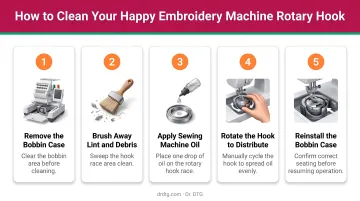
Clean the rotary hook area regularly, especially with frequent commercial use. The frequency of lint accumulation scales directly with production volume — a shop running multiple jobs per day needs this done more often than one running a few hours per week.
Thread Path and Tension Checks
Thread breaks that aren't caused by lubrication or timing issues usually trace back to the thread path or tension setup. Inspect the full path — tension discs, take-up lever, ceramic guides, and needle eye — for burrs, rough spots, or debris. Any roughness in the path will cut or abrade thread under load.
Needle orientation: the flat side (scarf) should always face backward. An incorrectly seated needle is a frequent cause of skipped stitches.
Checking bobbin tension with the drop test (per Happy/Texmac technical documentation at a target of 23–27 grams):
- Load the bobbin case and hold it by the free end of the thread
- Hang it 6–12 inches and dip your hand down quickly, then stop
- Correct: bobbin case unspools slightly and stops
- Too tight: doesn't unspool at all
- Too loose: unspools continuously
Thread quality directly affects tension consistency and break frequency. Happy/Texmac HCD Chapter 4 recommends quality 40-wt polyester or rayon embroidery thread — consistent diameter and finish reduce tension variation across long production runs. Dr. DTG stocks the full Isacord 40-wt polyester line (390 colors, 1,000m and 5,000m spools) as the US Master Distributor.
Needle and Rotary Hook Inspection
Needles: Happy Japan machines use DBxK5 industrial needles (common sizes include 75/11 and 80/12). Inspect needles regularly for bending or burring — a bent needle that contacts the hook even slightly will cause timing problems. Replace when performance drops, when you switch to a notably different fabric weight, or after any needle strike.
Dr. DTG stocks Groz-Beckert embroidery needles compatible with Happy Japan machines.
Rotary hook gap: Per verified Happy/Texmac HCD Chapter 4 documentation, the correct clearance between the hook point and the back of the needle at 25 degrees is approximately 0.1–0.15 mm. Incorrect timing or clearance at this point causes missed stitches, looping, thread breaks, and needle breaks. If skipped stitches persist after tension and needle checks, hook timing verification is the next step — and this is technician-level work.
Happy Embroidery Machine Maintenance Schedule
Exact intervals depend on your production volume and environment. A commercial shop running 8+ hours daily needs more frequent attention than one stitching a few hours per week. Use this as your reference framework.
| Interval | Key Tasks |
|---|---|
| Every 8 hours / per shift | Oil rotary hook (1 drop); clean lint from hook area and bobbin case; check thread path for snags; run test stitch after oiling |
| Every 40 hours | Oil needle bar felt pads, head rails, and all marked points; inspect needles and replace if bent or dull; check and balance upper and bobbin thread tension |
| Periodically (as needed) | Tighten loose screws; inspect accessible drive components for visible wear; deep-clean rotary hook zone with solvent; review error code history |
| Professional service | Hook timing calibration, sensor inspection, electrical checks, and full mechanical inspection — when recurring issues don't resolve with owner-level maintenance, or after extended high-volume use |
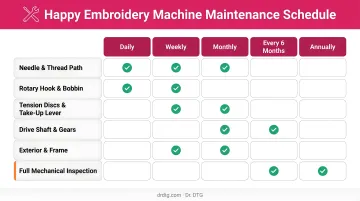
A note on professional servicing frequency: Happy/Texmac documentation directs users to return machines to an authorized dealer or service center for mechanical and electrical adjustment when needed. For commercial operations at high volume, proactive scheduling protects uptime and extends machine life. Dr. DTG's repair team can help you determine the right service cadence for your workload.
Conclusion
The machines that stay profitable are the ones that get consistent attention between jobs, not just when something breaks. For Happy Japan equipment, that means oiling the hook every 8 hours, cleaning before you oil, checking tension regularly, and replacing needles before they cause downstream problems.
Oiling, cleaning, needle changes, and tension checks are owner-level tasks that take minutes. Hook timing calibration, sensor work, and persistent error code diagnosis are technician territory. Attempting these without the right tools and training typically creates new problems on top of the original one.
For anything that falls into technician territory, Dr. DTG's repair team has been diagnosing and servicing commercial embroidery equipment since 2003 — including Happy Japan machines sold and supported directly. Reach them at 714-770-0969 or info@drdtg.com.
Frequently Asked Questions
Do embroidery machines need to be serviced professionally?
Yes. Owner-performed cleaning and oiling handles routine upkeep, but mechanical calibration, timing adjustments, and sensor work require professional service. Happy/Texmac documentation directs users to return machines to an authorized dealer or service center for electrical and mechanical adjustment when needed.
How much does Happy embroidery machine service cost?
No standard published rate exists. Onsite commercial service is typically billed as a per-day charge plus travel expenses (vehicle, fuel, hotel, and per diem where applicable), according to The Embroidery Warehouse's service page. Consistent preventive maintenance reduces how often you need those calls.
How often should I oil my Happy embroidery machine?
The rotary hook should be oiled every 8 operating hours (or every 2–3 bobbin changes during nonstop HCH/Journey operation). Needle bar felt pads and other marked points are oiled on the 40-hour schedule. Always clean lint from the hook area before applying oil.
What type of oil should I use?
Use only clear white sewing machine oil as specified by Happy/Texmac documentation. Never use WD-40, household lubricants, or cooking oils — they leave residue, attract lint, and accelerate mechanical wear.
What do Happy embroidery machine error codes E-050 and E-018 mean?
E-050 (C-Point error): the main shaft didn't return to its at-rest position. Press AUTO to clear; if that fails, manually rotate the shaft to C-point using a 3mm hex wrench through the rear access port. E-018 signals unusual main shaft resistance. If either code persists after basic troubleshooting, contact a qualified technician.
Can I do my own maintenance, or do I need a technician?
Oiling, lint cleaning, needle replacement, and tension checks are all owner-level tasks. Hook timing calibration, sensor replacement, and persistent error code diagnosis are best handled by a qualified technician — improper repairs can void your warranty and create deeper mechanical issues. Dr. DTG offers commercial embroidery machine repair services across the USA, with on-site service available in Southern California.