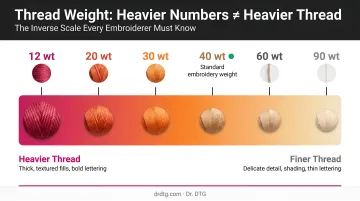
The numbering system doesn't help. Most embroiderers expect a higher number to mean a thicker thread — but it works the opposite way. A 40wt thread is thicker than a 60wt, and a 60wt is thicker than a 90wt. That counterintuitive logic trips up beginners and experienced operators alike.
This guide covers the full weight spectrum from top thread to bobbin thread, explains how fiber content interacts with weight, and gives you a practical framework for matching thread weight to your specific project and machine.
Key Takeaways
- Thread weight numbers are inverse — lower number = thicker thread (40wt is thicker than 60wt)
- 40wt is the standard top thread weight for machine embroidery — nearly all commercial designs are digitized for it
- Most home and semi-commercial machines use 60wt bobbin thread, which runs finer than the top thread
- Finer threads (60wt–80wt) preserve detail in small lettering; heavier threads (12wt–30wt) create bold, textured coverage
- Swapping thread weights without adjusting stitch density leads to thread breaks, over-stitching, or patchy coverage
What Thread Weight Actually Means in Machine Embroidery
The Measurement System
Thread weight is a length-per-mass measurement: a 40wt thread means 40 kilometers of that thread weighs one kilogram. The longer the strand needed to reach one kilogram, the finer the thread — which is why higher numbers equal thinner thread.
This is the opposite of needle sizing, where a larger number means a larger needle. Keep that distinction clear to avoid the most common setup errors.
Two main systems appear across thread brands:
- Weight (wt) — most common in embroidery; lower number = heavier thread
- Denier — a direct mass-per-length system where higher numbers indicate heavier thread; used more in specialty and industrial contexts
- Tex — international standard; grams per 1,000 meters; higher Tex = heavier thread
Most embroidery thread brands use the weight system, so start there.
Why the Default Matters
According to Superior Threads, Madeira, and Wilcom, commercial embroidery designs are digitized assuming 40wt top thread. That means stitch density, pull compensation, and underlay are all calculated for that specific thickness.
Swap to a 60wt thread without reducing density and the stitches crowd. Swap to a 30wt without opening up the spacing and the design jams. Thread weight is a built-in design parameter, not just a supply preference.
Top Thread vs. Bobbin Thread
Thread weight applies to both your top thread and your bobbin thread, and the two interact directly with machine tension. Most embroiderers pay close attention to top thread weight and treat bobbin thread as an afterthought. That's a mistake worth correcting early.
When top and bobbin weights are mismatched — or the bobbin weight doesn't match what the machine is calibrated for — you'll see one of two visible defects: bobbin thread pulling through to the top surface, or top thread looping on the underside.
The Thread Weight Spectrum: Common Weights and Their Best Uses
Machine embroidery thread spans roughly 12wt to 90wt+, with each range suited to distinct use cases.
Heavy Threads (12wt–30wt): Bold Coverage and Texture
12wt and 30wt threads are significantly thicker than the 40wt standard. They're used when you want a bold, raised, or hand-stitched aesthetic — decorative fills, wool-look designs, or oversized lettering.
A few practical notes for heavy threads:
- Sulky 12wt cotton recommends a size 16/100 needle — substantially larger than the standard 75/11
- Wilcom classifies 30wt as approximately Tex 35, suited for bold outlines and large fills
- Designs digitized for 40wt must have stitch density reduced when you switch to these weights — without that adjustment, heavy thread in a dense design causes binding, breaks, and machine jams
Standard Weight (40wt): The Embroidery Default
40wt is the benchmark. Every major thread authority — Superior Threads, Madeira, Impressions, Wilcom — confirms it as the standard weight for commercial machine embroidery. It delivers the best balance of coverage, color vibrancy, and compatibility across machine types and fabric applications.
For production shops, thread breakage and color drift directly affect output quality and downtime. Isacord 40wt polyester — available through Dr. DTG as a USA Master Distributor — is engineered for high-speed running with:
- Minimal breakage and strong washfastness
- Color stability across a 390-color catalog
- 1000m spools at $5.29 and 5000m spools at $9.95
The standard needle pairing for 40wt is a 75/11 embroidery needle — confirmed across Impressions, Madeira, and Wilcom.
Fine Threads (60wt–80wt): Detail Work and Specialty Applications
60wt thread is where top-thread and bobbin-thread territory start to overlap. Impressions confirms that 60wt is 25–30% thinner than 40wt, enabling lettering that 40wt physically can't produce cleanly at small sizes.
Published small-lettering benchmarks:
| Thread Weight | Minimum Letter Height (Approx.) |
|---|---|
| 40wt | ~4–5 mm |
| 60wt | ~3 mm (Madeira) |
| 75wt (Madeira Polyneon) | ~2.5 mm |
For 60wt, Madeira recommends dropping to a #65/9 or #70/10 needle for best clarity. WonderFil's DecoBob at 80wt is a cottonized polyester designed primarily for bobbins but used in the top for delicate freestanding lace and micro-detail applications.
Ultra-Fine Threads (90wt): Bobbin Work
90wt thread is primarily a bobbin-thread weight. Fil-Tec's Bobbin Line 90 is a spun polyester specifically designed for commercial embroidery bobbins, offering reduced bulk in dense stitch areas and improved flatness on the finished surface.
Brother's genuine SAEBT bobbin thread is 60wt, gauged for Brother machine tension. The right bobbin weight for your machine isn't universal — check your manual before assuming.
Thread Material and Weight: How They Work Together
Thread weight tells you how thick the thread is. Fiber content tells you how it behaves. A 40wt polyester and a 40wt rayon are the same thickness but perform differently under machine conditions.
| Material | Finish | Durability | Best Use |
|---|---|---|---|
| Polyester | Low-to-moderate sheen | High; colorfast, bleach-resistant | Workwear, caps, promotional goods, commercial production |
| Rayon | High, silky sheen | Moderate; not for harsh laundering | Decorative work, monograms, detail-focused designs |
| Cotton | Matte, natural | Moderate; higher lint | Decorative fills, natural-look embroidery |
| Metallic | High sparkle | Lower; prone to breakage | Accent stitching, decorative fills |
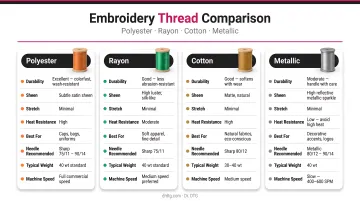
Madeira recommends polyester for robust goods and industrial laundering, rayon for softer decorative applications.
Material choice doesn't stop at the thread spool — it also determines which needle you should be running.
Needle Pairing by Material
Material type affects needle choice independently of weight:
- Polyester/Rayon 40wt → 75/11 embroidery needle
- Fine 60wt polyester/rayon → 65/9 or 70/10
- Heavy 12wt → 100/16 or 16/100 topstitch
- Metallic (any weight) → metallic needle with 2.0mm extra-long eye (Schmetz) to minimize breakage
OESD confirms that metallic thread requires reduced machine speed and lower needle tension regardless of what weight is listed on the spool — run a stitch-out sample on scrap fabric before starting any production run.
Matching Thread Weight to Your Project and Machine
Selecting the right thread weight means balancing your design requirements, your fabric, and what your machine can actually run. Most projects start in the same place — and only a few factors push you off the default.
Step-by-Step Selection Framework
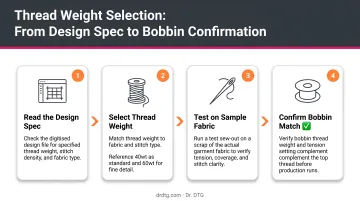
Start with your digitized design spec: Almost every design is digitized for 40wt. Use 40wt as your default unless something else on this list gives you a specific reason to change it.
Adjust for design scale: Shrinking a design below its digitized size crowds stitches together. Switching to 60wt or 80wt preserves legibility that 40wt would obscure. Scaling up significantly may allow a heavier thread to reduce stitch count while maintaining coverage.
Match thread to fabric weight: Lightweight or sheer fabrics (organza, fine knits) benefit from finer thread to minimize bulk and puckering. Structured fabrics (canvas, denim, caps) handle standard 40wt without issue. Keep in mind that stabilizer selection works in tandem with thread weight — they aren't independent variables.
Confirm bobbin weight against machine specs: Embroidery machines are calibrated for a specific bobbin thread weight. Running the wrong weight throws off tension even when the top thread is correct. Consult your machine manual or contact your dealer. Dr. DTG's team can walk you through this directly — call 714-770-0969 or email info@drdtg.com.
Common Thread Weight Mistakes to Avoid
Treating Designs as Thread-Weight Agnostic
The most common mistake: switching from 40wt to 60wt and running the same design file unchanged. Because 60wt is 25–30% thinner, the same stitch count in the same area produces over-stitching. The result is a stiff, raised surface and increased needle breakage as finer thread cannot fill that density without crowding.
The fix is straightforward: reduce stitch density when going finer, increase stitch spacing when going heavier. But you have to do it deliberately.
Using the Wrong Bobbin Thread
Grabbing a spool of regular 40wt sewing thread to fill a bobbin is a tension problem waiting to happen. Most bobbin cases are calibrated for 60wt — the standard for commercial and semi-commercial machines.
A mismatched bobbin weight throws the tension balance off, producing visible defects:
- Bobbin thread pulling up to the top surface
- Top thread looping underneath the fabric
Skipping the Test Sew
Published specs and software previews give you a starting point. They don't tell you how your thread, fabric, and machine condition will actually interact. A test sew is the only real proof.
This holds regardless of experience level. Thread brand, stabilizer type, fabric hand, and machine age all interact with weight in ways no chart fully captures. Run a test before committing to production — and treat the results as data, not inconvenience.
Thread weight touches every part of the output: density, texture, tension, and durability. Getting it right before production starts is faster than troubleshooting defects after the fact.
Frequently Asked Questions
What thread weight is standard for machine embroidery top thread?
40wt is the universal standard, confirmed by Superior Threads, Madeira, Impressions, and Wilcom. Nearly all commercial designs are digitized assuming this weight, and it offers the best balance of coverage, detail, and compatibility across most machines and fabrics.
What are common uses for 60wt and 90wt bobbin thread in embroidery?
60wt bobbin thread is standard for most home and semi-commercial machines, providing balanced tension when paired with a 40wt top thread. 90wt is preferred in commercial settings where reduced bulk and improved stitch flatness matter most in high-density designs.
Can I use bobbin thread in the top needle for embroidery?
Bobbin-specific thread isn't engineered for top-thread delivery speeds and will break under tension. For micro-detail work, use embroidery-specific fine threads like Madeira 60wt or Polyneon 75 instead.
Which is heavier, 40wt or 50wt thread?
40wt is heavier (thicker) than 50wt. Thread weight numbers are inverse — a lower number means more mass per unit length, so 40wt thread has more physical substance than 50wt.
What thread weight should I use for small lettering or detailed designs?
60wt supports lettering down to approximately 3mm; Madeira's Polyneon 75 handles down to 2.5mm. For lettering under ½ inch tall, stepping down from 40wt to a finer thread prevents individual stitches from crowding and maintains legibility.
Does changing thread weight require adjusting stitch density?
Yes. Switching from the weight a design was digitized for (typically 40wt) requires density adjustments:
- Finer threads: reduce density to avoid over-stitching
- Heavier threads: increase stitch spacing to prevent bulk and breakage