Skip service too long, and the consequences compound fast: dried lubricants create friction, friction accelerates wear, worn parts drift out of alignment, and suddenly what should have been a routine service call becomes a multi-component repair. For commercial embroidery shops, that sequence also means missed deadlines, wasted garments, and lost revenue.
This guide covers the recommended service intervals for different usage levels, the warning signs that service is overdue, what owners can handle themselves versus what requires a technician, and the real costs of letting maintenance slide.
Key Takeaways
- Professional service should happen annually for light home use; commercial machines may need it every 3–6 months depending on production volume
- Daily and weekly maintenance like cleaning lint, oiling key points, and checking needles directly reduces wear between professional services
- Needle replacement matters more than most owners realize: Impressions Magazine cites 8 hours of running time as the optimal needle lifespan
- Thread quality, environment, and stitch count all influence how frequently your machine needs attention
- Delaying service costs more in the long run — skipped maintenance turns routine upkeep into expensive part replacements
Why Regular Servicing Matters for Your Embroidery Machine
Unlike household appliances that run simple mechanical cycles, commercial embroidery machines synchronize dozens of components — needle bars, rotary hooks, take-up levers, tension systems — all moving in coordinated sequence at high speed.
That precision runs on tight tolerances. The Happy HCR2 maintenance manual specifies rotary hook timing at 23 degrees with a needle-to-hook clearance of just 0.1–0.2 mm. Upper thread tension is specified at 100–150 cN; bobbin tension at 25–35 cN.
Those specs aren't suggestions — they're the margins within which the machine forms a proper stitch. When mechanical drift pulls components outside those tolerances, stitch quality degrades visibly.
What Happens Without Lubrication
Lubrication prevents machine parts from wearing down quickly — skip it, and friction between metal components accelerates wear on bearings, shafts, and timing mechanisms. According to ZSK's maintenance documentation, contaminants like dust, lint, thread fluff, and moisture entering small mechanical spaces will:
- Drive up friction and heat
- Degrade cutting precision
- Increase operating noise
Even machines sitting unused experience lubricant degradation over time.
The Business Case
For custom apparel shops and commercial embroidery businesses, a machine that goes down mid-production run creates real, compounding costs: rejected output, wasted garments, rush repair bills, and strained client relationships. Preventive servicing is far less disruptive and less expensive than the alternative.
How Often to Service an Embroidery Machine Based on Your Situation
Service frequency isn't universal. The right interval depends on how heavily the machine runs, the conditions it operates in, and what supplies go through it.
Based on Usage Level
Usage level is the most straightforward starting point:
- Light home use (a few hours per week) — Annual professional service is standard. Wear accumulates slowly, so a once-yearly visit keeps the machine calibrated and clean.
- Moderate-to-heavy commercial use (multiple hours daily, multiple days per week) — Professional service every 3–6 months is the appropriate target. High-volume shops often switch to stitch count as a more reliable trigger than the calendar.
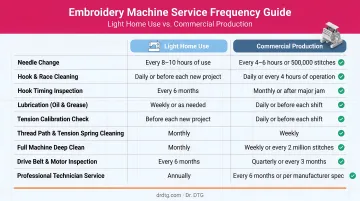
For specific service intervals on Happy Japan and Xtreme Tech XTPro machines, the manufacturer's maintenance documentation included with your machine is the authoritative source. Dr. DTG's technical team at 714-770-0969 can also help you build a maintenance schedule calibrated to your actual production volume.
Based on Stitch Count
For busy shops, stitch count is a more precise maintenance trigger than calendar time. Check your machine's documentation for model-specific thresholds — intervals vary by brand and series, and your manufacturer may tie specific tasks (hook cleaning, lubrication, needle replacement) to defined stitch milestones.
Based on Environmental Conditions
Your production environment directly shapes how often you need to clean. ZSK's documentation identifies dust, lint, thread fluff, and moisture as contaminants that cause mechanical problems — and they build up fast in tight spaces. Machines operating in:
- Dusty or high-lint environments — need more frequent cleaning and inspection
- High-moisture environments — face contamination risks that accelerate mechanical issues
- Low-air-circulation spaces — accumulate debris faster around the hook area and thread path
If your production environment isn't climate-controlled or tends to generate high ambient lint, tighten your cleaning intervals accordingly.
Based on Supply Quality
Thread quality directly affects how often your machine needs attention. Impressions Magazine links poor-quality thread to thread breaks, slow sew speeds, lint buildup, and tension issues — all of which shorten the window between cleanings. Madeira USA recommends keeping the thread path, tension discs, and needle area clear of lint buildup as a baseline practice.
Higher-quality thread — like Isacord, which Dr. DTG distributes as the US Master Distributor — is engineered to run smoothly and shed less lint. Fewer breaks and less debris means longer intervals between full cleanings and less stress on the tension system overall.
Signs Your Embroidery Machine Needs Servicing Now
These aren't signals to note and address at the next scheduled interval. They mean service is overdue.
Performance Red Flags
- Frequent thread breakage (top thread or bobbin)
- Skipped stitches or inconsistent stitch formation
- Looping thread or bobbin thread visible on the top surface of fabric
- Tension irregularities that persist after re-threading
Impressions Magazine links worn needles directly to thread breaks, skipped stitches, and shredded thread — and specifies 8 hours of running time as the point where needles should be replaced. If you haven't tracked your needle hours, that alone can explain multiple performance symptoms.
Mechanical Indicators
- Grinding, knocking, or rattling sounds during operation
- Increased vibration compared to normal running
- Sluggish needle movement or stiff operation
- Machine running noticeably louder or warmer than usual
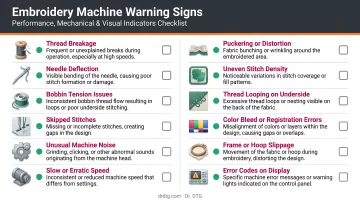
These point to lubrication failure or developing mechanical wear. A Ricoma support document also notes that improper threading can produce similar symptoms, so rule out operator and setup causes first. If re-threading doesn't resolve it, the machine needs professional attention.
Visual and Output Indicators
- Embroidery outlines no longer aligning precisely
- Uneven fill density across a design
- Designs that held quality at lower stitch counts now showing drift
These signal that timing or tension calibration has slipped. At-home maintenance cannot correct either issue.
DIY Maintenance vs. Professional Service: What the Schedule Should Look Like
What You Can Do at Home
Consistent at-home maintenance is what keeps the gap between professional services manageable. Based on manufacturer documentation:
Daily (for commercial machines in production):
- Clean the rotary hook and surrounding area
- Oil the rotary hook — ZSK specifies 1–2 drops; Barudan's Elite Jr. chart calls for oiling the rotating hook every 4–6 hours of use
- Clean thread trimmers and the bobbin-thread monitor area
Weekly:
- Remove thread waste from trimmer blades
- Inspect the thread path for lint buildup along tension discs and in the needle area
Monthly / as needed:
- Check toothed belt tension (per ZSK W head documentation)
- Inspect and replace needles — at minimum after every 8 hours of running time, or immediately if bent, dull, or broken
- Wipe down external surfaces
Important: Not every machine requires user oiling. Some components — ZSK notes that aluminum needle bars and lifting magnets are maintenance-free and must not be oiled. Always follow your specific machine's manual rather than applying generic oiling advice.
What Professional Service Covers
At-home maintenance keeps the machine running day-to-day, but it cannot substitute for professional service. A proper professional service includes:
- Full disassembly and cleaning of internal components inaccessible during routine cleaning
- Inspection and replacement of worn bearings, belts, and mechanical components
- Timing recalibration (needle-to-hook clearance, take-up lever timing)
- Tension system adjustment across all heads
- Full test stitch-out to verify calibration before return to production
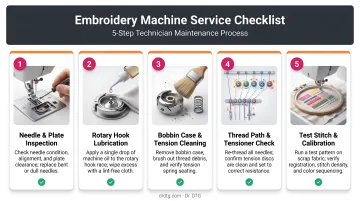
Attempting timing recalibration without training risks damaging sensitive mechanical and electronic systems. The tolerances involved — like the 0.1–0.2 mm needle-to-hook clearance specified in Happy's HCR2 manual — require proper tooling and experience to set correctly.
Getting Service Support
Dr. DTG provides commercial embroidery machine repair services across the US — on-site for Southern California customers, and return-to-depot service for shops in other states. The same technicians who sell and support Xtreme Tech XTPro and Happy Japan machines handle the repairs, with OEM parts inventory on hand in Brea, California.
Not sure whether your machine needs service now or can wait for its next scheduled interval? Reach out directly:
- Phone: 714-770-0969
- Email: info@drdtg.com
- Repair ticket: drdtg.com/submit-ticket (include your machine's make, model, serial number, and a description of the issue)
Frequently Asked Questions
How long does an embroidery machine last?
Well-maintained commercial embroidery machines routinely last 15–20+ years. Consistent lubrication, regular cleaning, and scheduled professional service keep friction low and prevent the component wear that cuts machine life short.
What are the maintenance requirements for an embroidery machine?
Daily requirements cover rotary hook cleaning and oiling, lint removal along the thread path, and needle inspection. Replace needles around every 8 hours of run time, and schedule professional service at intervals matched to your production volume.
How often should I oil my embroidery machine?
It depends on your machine model. Barudan's Elite Jr. oiling chart specifies oiling the rotating hook every 4–6 hours of use; ZSK calls for daily oiling with 1–2 drops. Always consult your machine's manual first — some components are maintenance-free and should never be oiled.
Can I service my embroidery machine at home?
Basic maintenance — lint cleaning, needle changes, and oiling at designated points — is owner-appropriate. Timing recalibration, internal disassembly, and belt and bearing inspection require a trained technician.
How much does it cost to professionally service an embroidery machine?
Service costs vary by machine type, age, condition, and location. On-site commercial service is typically billed as a day-rate labor charge plus expenses and parts. Contact Dr. DTG at 714-770-0969 for a service quote specific to your machine model and situation.
How do I know when my embroidery machine needs servicing?
Key warning signs include frequent thread breaks, skipped stitches, grinding or rattling sounds, stiff operation, increased vibration, and misaligned embroidery output. Any of these warrants immediate service rather than waiting for the next scheduled interval.